

The moon has always been shrouded in mystery, casting a silvery glow that stirs the human soul with wonder. Cultures across the world have peered into the night sky and spun tales of divine beings who rule over the lunar sphere. These mythic figures are often goddesses, cloaked in the soft radiance of moonbeams, each with stories that weave through the fabric of folklore and legend.
These celestial ladies often embody the spirit of the moon itself, reflecting its phases and its influence over the earth. They may be guardians of the night, symbols of fertility, or keepers of ancient wisdom. As we turn our gaze skyward and ponder these deities, we become part of an age-old human tradition—marveling at the luminous orb that travels the nightscape and the mythical beings that call it home.
[su_button url=”https://amzn.to/4iB8iJY” background=”#a62def” color=”#ffffff” size=”10″ icon=”icon: magic”]Shop Witchy Supplies[/su_button]
1) Selene

Selene, she’s the night’s reigning queen in Greek mythology. She’s recognized as the very essence of the moon itself, driving her silver chariot across the sky. Her lineage is nothing short of celestial; she’s the daughter of Titans Hyperion and Theia, and her siblings include Helios, the sun god, and Eos, goddess of the dawn.
Legends whisper of her romance with a mortal man named Endymion. Zeus granted him eternal slumber so he would never age or die, allowing Selene to visit him each night as he sleeps endlessly, their love forever frozen in time. She’s a figure of perpetual beauty, softly illuminating the dark, draped in the cool allure of moonlight.
2) Chandra
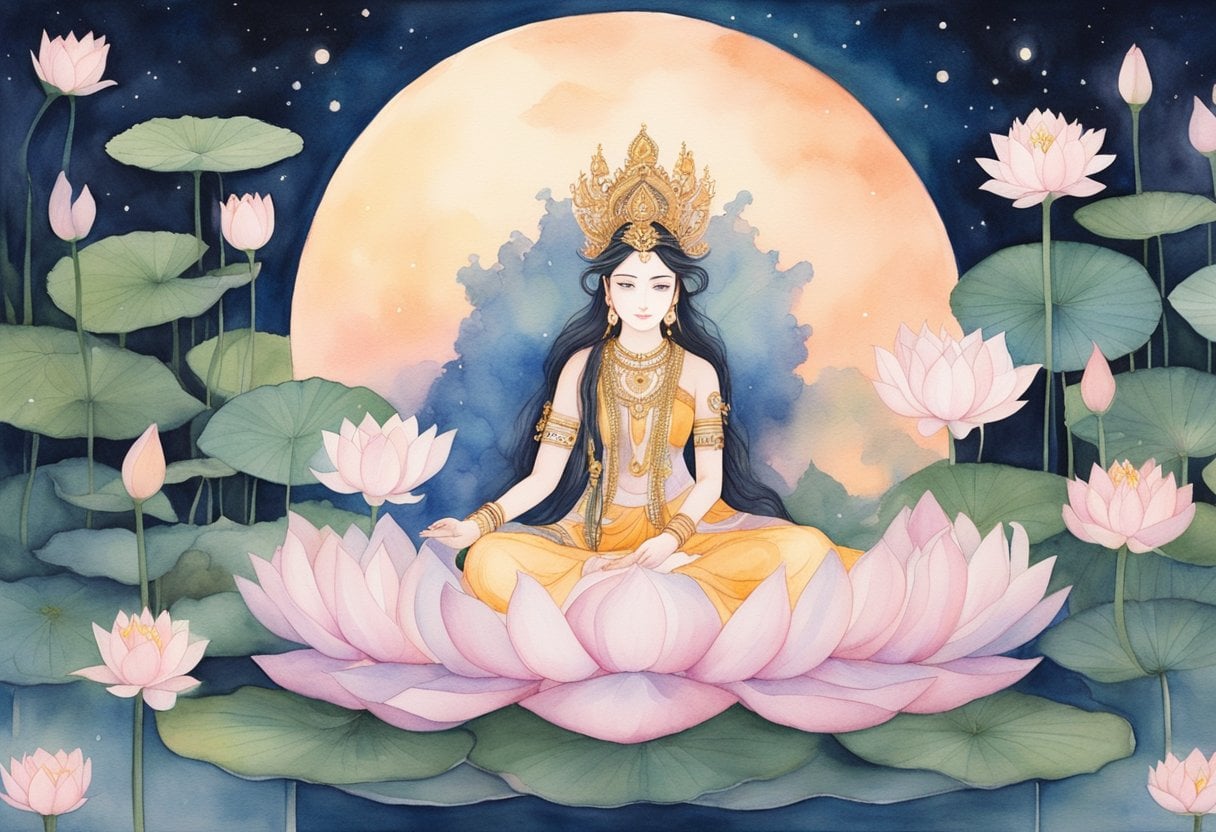
Chandra, the Moon God in Hindu mythology, rides across the sky in a silver chariot pulled by ten white horses. As one of the Navagrahas, his celestial influence extends over all things luna. Scholars and devotees alike recognize Chandra’s lunar domain, where he governs emotions and the mind, reflecting his cool and soothing energy.
Legends often speak of Chandra’s entangled love stories and cosmic battles. He’s known for having swept Tara, the star goddess, away, stirring cosmic conflicts among deities. This liaison brought Budha, the planet Mercury, into the grand scheme of celestial beings. As a symbol of cyclical time, Chandra’s waxing and waning echo the rhythms of life itself.
3) Mayari

Mayari is a prominent figure in Philippine mythology, particularly in Tagalog folklore. She is the goddess of the moon, and her name translates to “the beautiful one.” According to legend, Mayari and her brother, Apolaki, the god of the sun, once ruled the sky together. However, they fought each other for dominance, resulting in Mayari losing her left eye. Despite this, she remained a powerful and revered deity, controlling the nighttime and the tides. Mayari is often depicted as a beautiful woman with only one eye, symbolizing her sacrifice and the cyclical nature of the moon.
She is associated with femininity, beauty, and the mysteries of the night. In some traditions, she is also seen as a protector of women, especially during childbirth. Mayari’s presence in Philippine mythology highlights the importance of celestial bodies and the balance between light and darkness in the cultural beliefs of the Filipino people.
4) Artemis

She roams the moonlit wilderness, her silver bow shimmering with the stars. Artemis, in ancient Greek lore, is revered as the goddess of the hunt and the wild, eternally youthful and fiercely independent. Twin sister to Apollo, her myths paint a picture of a dauntless protector, guardian of the forests, and patroness of women and childbirth.
Her following whispered her name with reverence, for she watched over the natural world and its inhabitants with a mother’s keen eye. Many a tale speaks of her swift retribution to protect her purity and her companions, the nymphs who danced by her side beneath the silvery glow of her celestial domain.
5) Hecate

Among the moon goddesses, Hecate shines with a unique mystery. She’s not your everyday deity; she’s got a serious job guarding the crossroads and guiding souls in the afterlife. With her torches lighting up the night, she’s got a reputation as the go-to goddess for magic and witchcraft, not to mention her entourage of dogs and the occasional serpent.
She doesn’t stick to just one form—sometimes she’s three-faced, keeping an eye on everything coming and going. Nighttime is her domain, no question about it. But don’t get the wrong idea; she’s not all spooky business. Hecate plays the wise guide, helping folks out, especially when they’re dealing with otherworldly stuff. If you’re looking for some divine magic under the moon’s glow or maybe some protection from the things that go bump in the night, she’s the one you’d want on your side.
6) Ix Chel

She was the Mayan moon goddess, Ix Chel, revered in ancient lore for her dominion over fertility and birth. Crafted in the visage of an old jaguar, she wielded the powers of medicine and midwifery. Myths paint Ix Chel with a dual nature; she was not just a nurturer, but also held sway over death’s mysteries. The Dresden Codex offers a glimpse into her identity, depicting her with serpentine features and a link to celestial cycles.
Ix Chel’s tale intertwines with that of the Maya people, a weave of light and shadow. She danced through their pantheon as “Lady Rainbow,” reflecting the nuances of life with her many colors. Legends whisper her name as “She of the Pale Face,” a moonlit echo in the night sky. Her influence stretched to the cycles of the harvest, where growth and decline spun under her watchful eyes. The ancients gazed up, finding her silhouette within the moon’s wax and wane, a constant presence in the heavens above their vibrant culture.
7) Phoebe

In Greek mythology, Phoebe glimmers as a Titaness, her story woven with threads of light and insight. This daughter of Uranus and Gaea held the radiant title of the goddess associated with intellectual prowess. They say Phoebe’s brilliance was such that she secured her place at the acclaimed Oracle of Delphi, sharing her gift of prophecy.
She was a matriarch in her own right, the grandmother of Apollo and Artemis, two of the most venerated Olympian deities. Unlike her Olympian descendants who became more prominent in later tales and worship, Phoebe herself was often seen as a more primal deity, representing prophetic power and intellectual illumination.
8) Rhiannon

She emerges from Welsh mythology, cloaked in mystery and moonlight. Rhiannon is a deity whose tales are woven into the fabric of the Mabinogion, enchanting those who encounter her narrative. Her association with the moon and horses creates an otherworldly presence that lingers in ancient stories. She rides with graceful defiance, confronting the harsh twists of fate with unwavering resilience.
Legends speak of her marrying Prince Pwyll and the tragic circumstances that followed. An unjust accusation forces her to endure a punishment that echoes with the sorrow of a mother’s love lost and found. Rhiannon’s story is an echo in the valleys of Wales, reminding us of the endurance of the spirit and the enchanting weave of myth that connects us to the past.
9) Chang’e

In Chinese mythology, Chang’e graces the heavens, a goddess who weaves silver threads of light across the night sky. She’s often depicted as a gracious deity, holding dominion over the moon’s cycles and the night’s serene beauty. She’s the whispered secret in the silvery moonlight, threading through Chinese folklore with grace.
Lit by her gentle glow, lovers find solace in her tender watch. Stories of her benevolence float through time, as she’s said to govern the ebb and flow of emotions, much like the tide’s dance with the moon. Her influence is subtle, yet those who pay heed to the night’s sky feel her presence, as constant as the moon’s phases.
10) Diana

In ancient Roman myth, Diana shines as the moon goddess. Draped in the silvery glow of moonlight, she guards the wilderness and looks out for the well-being of animals, especially the sacred deer. Myth recounts her birth on the isle of Delos, making her the twin of Apollo, the sun god.
Diana, forever an enigmatic maiden, keeps her heart and her forests untouched. She relishes the solitude of the woods, along with the company of nymphs and wildlife. This celestial archer’s aim is unmatched; she’s the protector of hunters, aligning her arrows with the rhythms of the natural world.
[su_button url=”https://amzn.to/4iB8iJY” background=”#a62def” color=”#ffffff” size=”10″ icon=”icon: magic”]Shop Witchy Supplies[/su_button]
