

The moon’s cyclical dance through its phases has captivated human curiosity since ancient times. Shifting mysteriously through its stages, the moon symbolizes a rhythm that weaves through our lives, marking the passage of time and influencing cultural practices. Its phases, driven by the moon’s position relative to Earth and the sun, have both a scientific explanation and a mystical allure.
Observing the moon traverse from new to full and back again, humans have noticed the calm of the new moon, the dynamism of the waxing phases, the completeness of the full moon, and the introspection during the waning. This lunar odyssey is not just a celestial spectacle; it has implications for Earth’s tides, ecosystems, and even, as many anecdotes suggest, human behavior. The interplay of light and shadow across the moon’s surface tells a story of cosmic interconnection that has profound meaning for many people around the world.
Key Takeaways
- The moon phases are a result of its orbital positions.
- They have not just fascinated cultures but also affect our planet.
- Each phase of the moon holds unique meanings in various cultures.
Understanding the Lunar Cycle

The dance of Earth’s companion through its phases tells a story stretching across the ages. Here’s a peek into the mechanics of this celestial rhythm.
Fundamentals of Moon Phases
As anyone gazes up at the night sky, they witness the moon subtly shifting shape. These changes, known as the moon phases, are a direct result of the moon’s orbit around Earth. The phases occur in a precise order: New Moon, Waxing Crescent, First Quarter, Waxing Gibbous, Full Moon, Waning Gibbous, Last Quarter, and Waning Crescent. The moon doesn’t glow on its own; instead, its phases are the result of sunlight reflecting off its surface at varying angles.
Here’s a quick list mapping these changes in order:
- New Moon: The moon is between Earth and the sun, invisible to us.
- Waxing Crescent: A sliver of light grows on the right side.
- First Quarter: The moon shows its half-lit face.
- Waxing Gibbous: More than half of the moon illuminates the night.
- Full Moon: The moon’s fully lit sphere enchants viewers.
- Waning Gibbous: Light slowly recedes from the right.
- Last Quarter: Another half-moon, but light wanes to the left.
- Waning Crescent: The light dwindles to a final sliver.
The Lunar Month
One might ponder the duration of this enthralling show. They call it the lunar month, and it spans approximately 29.5 days. Imagine the moon tracing a path in space that keeps it bound to Earth—this is its orbit. The lunar cycle’s length isn’t arbitrary; it’s the time it takes for the moon to return to the same position relative to the sun as seen from Earth. Day by day, the moon’s position shifts slightly, offering everyone a new visage until the cycle recommences with the next New Moon.
Stages of the Moon Phases
The journey the Moon takes through its phases presents a celestial dance that has enchanted humanity for centuries. These phases are a play of shadows and light as the Moon orbits Earth, revealing different portions of its illuminated side.
New Moon
During the New Moon, they witness the beginning of the lunar cycle. The Moon is aligned between Earth and the Sun, rendering it virtually invisible against the night sky, as its illuminated side faces away from Earth.
Waxing Crescent
As a sliver of light starts to emerge, they call this the Waxing Crescent phase. This is when the Moon reveals a thin crescent on the right side, as seen from the Northern Hemisphere, signaling a buildup to the expanse of brightness.
First Quarter
They say by the First Quarter, the Moon reaches a compelling milestone in its journey—a half moon. Here, half of the Moon’s surface is lit up and visible, resembling a celestial divide between light and dark.
Waxing Gibbous
Following the First Quarter, the Moon transitions into the Waxing Gibbous. The Moon’s illuminated part grows larger, but it isn’t quite full yet. It is as if the Moon is swelling with light, building anticipation for what’s to come.
Full Moon Phase
The Full Moon Phase is when the Moon reveals its fully lit face to Earth. They often associate full moons with mysticism, marking a period of high energy and heightened emotions.
Waning Gibbous
After the apex of the Full Moon, the Waning Gibbous begins. The Moon starts to subtly diminish in luminosity. It’s slowly saying goodbye to its full glory, inching away from the spotlight.
Third Quarter
They find the Third Quarter similar to the First, but reversed. In the Third Quarter, the left half of the Moon is visible, and it’s another half moon, but this time it’s waning, losing light as it moves further along its cycle.
Waning Crescent
The final chapter before rebirth is the Waning Crescent. This is when only a slender crescent is visible, mirroring the Waxing Crescent but on the opposite edge. It’s like a whisper from the Moon, hinting at the new cycle to come.
The Impact of Sun-Earth-Moon Dynamics
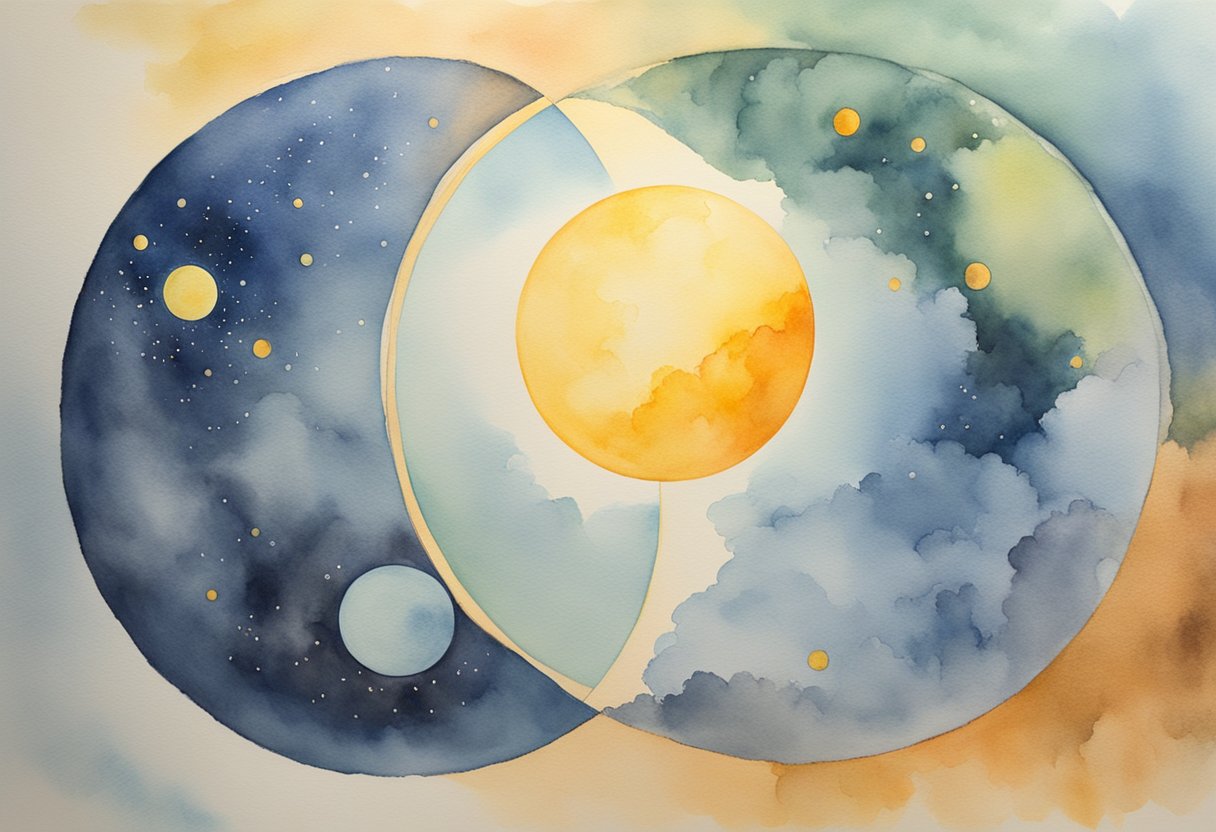
Dancing in the cosmos, the Earth, Moon, and Sun perform an eternal ballet, creating the enchanting phases of the moon we observe in the night sky. This celestial show is a direct result of the positioning and movements of these astronomical bodies.
Earthshine and the Darkened Moon
When the Moon appears to rest in the shadowy embrace of the night, one may sometimes see a faint glow on its unlit portion. This phenomenon, known as “earthshine,” occurs when sunlight bounces off the Earth’s surface and then softly illuminates the shadowed side of the Moon. One could imagine it as the Earth sending a hushed whisper of light to its silent companion in space.
The Sunlit Part
On the flip side, the part of the Moon bathed in sunlight reveals the lunar phases we are so familiar with. As the celestial dance progresses, the Sun casts its radiant beams upon the Moon’s surface, which we see from Earth as a growing or shrinking circle of light. These phases range from the new moon, with its hidden face, to the full moon, with its grand, luminous presence. The bright patch grows during the waxing period and retreats as the moon wanes, a mesmerizing cycle reflective of time’s constant march.
Eclipses and their Mystique
Eclipses have long captivated humanity, providing a celestial dance that underscores the intricate workings of our solar system. They’re rare occurrences when the Earth, Moon, and Sun align, either plunging our Moon into shadow or our day into temporary night.
Lunar Eclipses
In a lunar eclipse, Earth takes center stage between the Sun and the Moon, casting a shadow that shrouds the latter. They’re bewitching spectacles, sometimes bathing the Moon in a dusky red hue during a total eclipse – a phenomenon often called a “blood moon.” Lunar eclipses can only happen during a full moon, and the sight is a shared experience; anyone on the night-side of Earth can witness the event.
- Penumbral Lunar Eclipse: Only the outer shadow of Earth falls on the Moon’s surface.
- Partial Lunar Eclipse: A portion of the Moon drifts through Earth’s full shadow, creating a partial cover.
- Total Lunar Eclipse: The Moon is fully engulfed by Earth’s umbra, often showcasing a red tint.
Solar Eclipses
They say solar eclipses are nature’s grandest spectacle. When the Moon waltzes directly between the Sun and Earth, it can cast a beguiling shadow over our planet. These phenomena are a daytime drama and can only occur at the new moon when the alignment is just right. Solar eclipses have a narrower viewing path compared to their lunar counterparts, meaning they’re visible from a smaller area of Earth.
- Partial Solar Eclipse: The Moon covers only a part of the Sun as seen from Earth.
- Annular Solar Eclipse: The Moon is too far to completely cover the Sun, leaving a “ring of fire” visible.
- Total Solar Eclipse: The Moon entirely obscures the Sun, momentarily casting a shadow over a thin slice of Earth.
Blue Moon and Rare Events
Imagine a blue moon combined with a lunar eclipse — it’s a sight so rare it feels like the stuff of legend. A “Blue Moon” isn’t actually blue; it’s the name given to a second full moon within a single calendar month. Now picture this extra full moon aligning perfectly for an eclipse, which might happen “once in a blue moon.” Eclipses themselves are already rare, but coupling them with a Blue Moon? That’s an event for the storybooks.
Moon Observations Across Hemispheres

As Earth spins and we gaze upward, the moon serenades us with its perpetual cycle, revealing itself in slivers of light or in its full, luminous glory. Observers in different hemispheres are treated to their own unique celestial dance, each with its distinct perspective of the moon’s voyage through the night.
Northern Hemisphere Perspectives
In the Northern Hemisphere, spectators witness the moon’s phases unfold in an exquisite sequence. They see the waxing crescent with its light gently caressing the right side, and as the lunar days progress, the moon transitions into a bold and clear-cut first quarter, appearing as a half moon. From there, it blossoms into a waxing gibbous, more illuminated each night, until it reaches the grandeur of the full moon. The display is a slow waltz in reverse for the waning phases, with light gently receding from right to left.
Southern Hemisphere Perspectives
Flip the view upside down, and the Southern Hemisphere offers its own rendition of the moon’s phases. Observers there experience the waxing crescent with light glowing on the left. The first quarter still shows half of the moon’s face, but the illuminated part is the opposite of their Northern neighbors. Following this, the waxing gibbous grows night by night, and when the moon unveils itself fully, the full moon emerges, just as awe-inspiring as anywhere else on Earth. The phases diminish again, this time the light waning from left to right, disappearing into the shadowy embrace of the new moon.
The Moon’s Influence on Culture and Mythology
Since time immemorial, the moon has captivated countless cultures, weaving itself deeply into their mythologies and traditions. The full moon phase, often the most recognized due to its luminous presence in the night sky, has held significant meaning in various societies. To some, a full moon represents completion and the cyclical nature of life. They believe it’s a time of heightened intuition and emotional clarity.
Gibbous moons, with their peculiar bulging shape, symbolize anticipation and refinement. They’re like a crescendo in the lunar symphony, building up to the full moon’s climax. Societies have looked to this phase as a time for tweaking strategies or finalizing plans.
When it comes to the crescent moon, you’re dealing with a symbol of potential and promise. It’s the cosmic sliver signaling new beginnings. Think of those nights when you’ve spotted the crescent; didn’t it feel like something in the air whispered, “Something new is on the horizon”?
The old moon, also known as the waning crescent, is all about release, reflection, and rest. It signifies the time to let go of what no longer serves you, to contemplate one’s journey, and to rejuvenate in preparation for the next cycle.
In many tales and beliefs, these moon phases are attributed to various deities and cosmic forces. The moon’s dance through its phases is a narrative, each step rich with symbolic milestones. This dance has been an inspiration for countless works of art, poetry, and storytelling, where the moon’s glow guides characters and enchants landscapes with its mystical light.
Scientific Insights into Lunar Phases
Picture the Moon as it dances through the night sky, shifting its shape with a rhythm that’s been constant since time immemorial. The celestial mechanics behind this lunar ballet are as mesmerizing as they are precise, and they offer a fascinating glimpse into the workings of our solar system.
Measuring Moon Phases
To unravel the mystery of the Moon’s shifting appearance, one must understand the role of angles and illumination. As the Moon orbits Earth, the angle at which sunlight hits it changes, revealing varying portions of its surface to us in a sequence of phases:
- New Moon: Our satellite’s sunlit side faces away from Earth, rendering it invisible to us.
- Waxing Crescent: A sliver of light emerges, growing over time.
- First Quarter: Also known as the half-moon, half of the lunar disk is illuminated.
- Waxing Gibbous: The illuminated part expands, heading toward full illumination.
- Full Moon: Earth’s companion is fully lit, showcasing its face in full glory.
- Waning Gibbous: Light recedes, initiating the cycle of decrease in visibility.
- Last Quarter: Another half-moon, but now the decreasing light is on the opposite side.
- Waning Crescent: The cycle closes as the Moon’s light dwindles into a thin crescent once more.
Astronomers chart these transitions with meticulous precision, ensuring each phase is predicted with captivating accuracy.
Diameter and Visibility
The Moon’s apparition is not only about light and shadow but also its apparent size in the sky. Its diameter—about 3,474 kilometers—remains constant, yet its distance from Earth can vary slightly, affecting how large it seems to us.
During the intermediate phases, like the waxing and waning crescents, the lunar theater plays with the Moon’s visibility. One can imagine the ecliptic—the apparent path the Sun takes across the sky—as the stage where this celestial spectacle unfolds, with the Moon’s phases serving as scenes in an astronomical act that never ceases to enchant and engage.
In every phase, the Moon shares a secret of the cosmos, a tale of its eternal roundabout with Earth and the Sun, fascinating and mystical to behold. It’s an enigmatic guide on the path of understanding the vast expanse we call home.
