
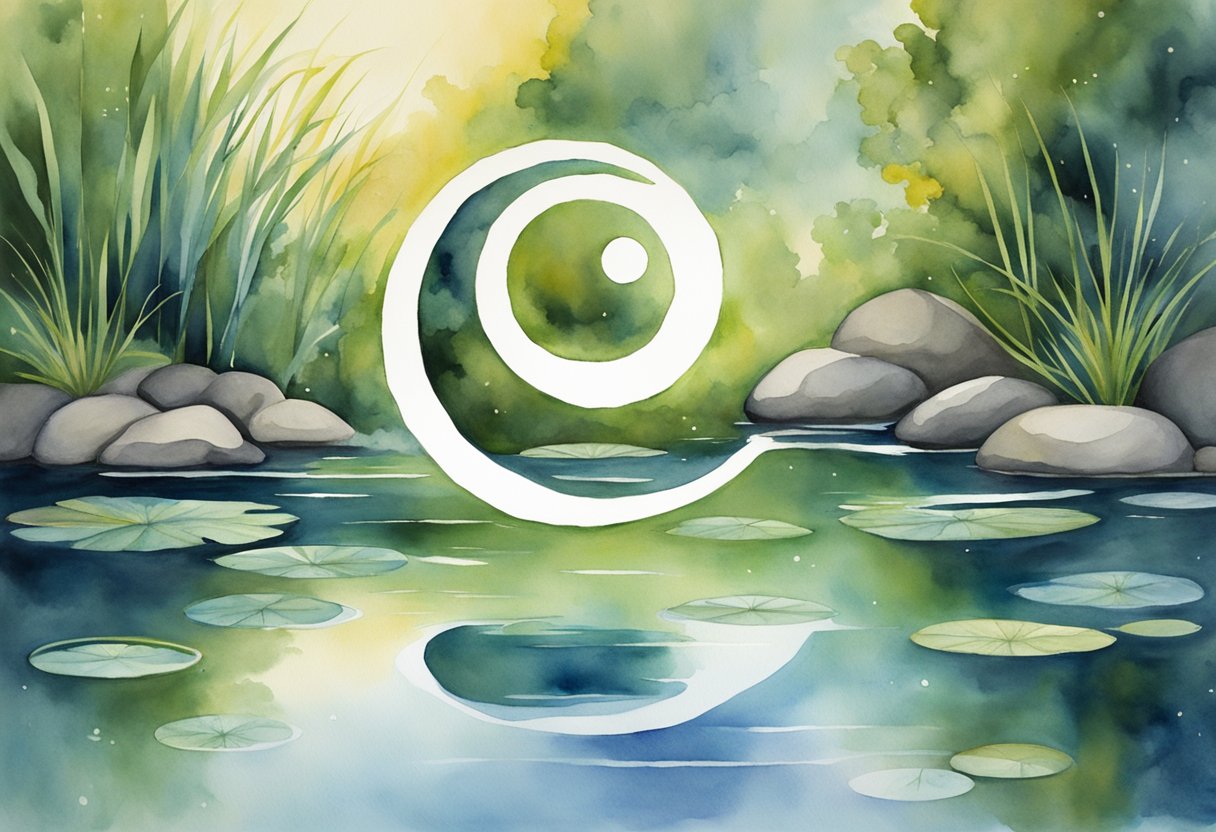
The concept of Yin Yang is as enchanting as it is philosophically profound. Imagine you’re holding the well-known symbol of Yin Yang – the Taijitu- in your hands: a circle divided into swirling dark and light segments. This symbol represents the intrinsic duality in the universe, the unseen dance between two polar forces. It suggests that seemingly opposing elements are interconnected and interdependent, coexisting in a natural harmony. As you delve into the mystical properties of Yin Yang, you become privy to a worldview that sees the cosmos as a balance of contrasts.
As you explore further, you discover the historical richness of Yin Yang, originating from ancient Chinese thought. The philosophy once whispered secrets of existence to sages and now humbly imparts wisdom to the curious minds of today. Yin Yang elegantly captures the continuous and dynamic exchange in the natural world and human endeavors. It reflects in the changing of seasons, the ebb and flow of tides, and even the balancing act in your personal life between rest and activity. The Taoist cosmology treats Yin Yang as a roadmap for achieving balance, offering practical guidance for harmonious living in a complex world.
Key Takeaways
- Yin Yang reflects a mystical perspective on the universe’s balanced dualities.
- Its roots in ancient Chinese cosmology inform both natural and human realms.
- The philosophy offers practical paths to harmony in contemporary life.
[su_button url=”https://amzn.to/4iB8iJY” background=”#a62def” color=”#ffffff” size=”10″ icon=”icon: magic”]Shop Witchy Supplies[/su_button]
Historical Context and Symbolism

Ancient Origins
The concept of Yin and Yang is ancient, tracing back to Chinese cosmology and philosophy. Your connection to this symbol links you to Zou Yan, an influential philosopher who theorized that life goes through five phases, and within these, Yin and Yang are the underlying forces. These ideas were written in the “I Ching” or “Book of Changes,” a text that’s been impacting lives since at least the third century BC. Picture it: sages interpreting hexagrams to explain the universe’s complexities—that’s your Yin Yang’s lineage.
Taoism and Yin Yang
You’ll find the roots of Yin and Yang deeply embedded in Taoism, a rich tradition where balance and harmony are the names of the game. In this context, Yin (earth, darkness, femininity) and Yang (heaven, light, masculinity) are like Cosmic BFFs—they can’t exist without each other. Their dance keeps the universe humming along, and your understanding of this delicate balance can influence your perception of life’s ebbs and flows.
Symbolism of the Taijitu
The iconic Yin Yang symbol, or Taijitu, is one heck of a mystical emoji. Its design screams harmony with a dash of contradiction. Looking at the black and white swirls, you’ve got a tangible representation of life’s dual nature. The dots? Those remind you that nothing is absolute—you can find a speck of good in the bad and vice versa. Whether you’re sporting it on a bracelet or meditating on its curves, the Taijitu whispers its wisdom: life is about embracing the balance of opposites.
Conceptual Foundations
Principles of Duality
In the realm of yin and yang, everything you see and experience is grounded in duality. The universe operates on the principle that all things exist as inseparable and contradictory opposites, like two sides of the same coin. For instance, day can’t be without night, and light needs darkness to be known. Each pair of opposites brings about balance and harmony in the natural world, a balance that is constantly sought after and revered for its capacity to align with the larger cosmic order.
Yin and Yang Characteristics
Yin and yang aren’t just abstract ideas; they are manifested in all aspects of life. Yin embodies the essence of darkness, cold, femininity, and the moon’s mysterious glow. It’s associated with aspects of life that are often described as passive, inward, and downward moving. In contrast, yang stands for light, heat, masculinity, and the sun’s radiant energy. Yang captures your outward, active, and ascending inclinations. The characteristics of yin and yang are fundamental to grasping their magical influence on life’s rhythms and patterns.
The Dynamic Interplay
Now, picture yin and yang not as static fixtures but as an ongoing dance of energies. This dynamic interplay leads to transformations as fundamental as the shift from day to night or the seasonal swing from hot to bright summers then back to cold, dark winters. It’s this perpetual motion and mutual transformation that sustains the cycle of life and keeps the universe humming. Acknowledging the unity of opposites gives you insight into how magical practices might seek to harmonize these energies within yourself and your surroundings.
Yin Yang in Natural World

Seasonal Changes
Spring and Summer: These are your Yang times of the year. Energy is increasing, days get longer, and life bursts forth with vibrancy. The fire element often associates with the warmth and activity of these growing months. On the flip side, wood is linked with spring’s growth energy, symbolizing life’s expansion and flexibility.
- Autumn and Winter: Yin dominates during these chilly and darker months. Yin brings about a sense of contraction and introspection, like nature taking a rest. The shorter days and cooler climate reflect a time for conservation and preparation. In this colder part of the cycle, water becomes a significant element, representing the deep, nurturing, and often hidden energies at work.
Environmental Influence
Mountains and Earth: Ever heard the phrase “as solid as a rock”? That’s your Yin right there, representing the stable, unmoving qualities of mountains and the earth beneath your feet. These elements remind you of endurance, patience, and the importance of strong foundations.
- Climate and the Moon: Although they might seem unrelated, the shifting climate patterns and the phases of the moon are both dance partners in the Yin Yang tango. Climate embodies the unpredictable, often forceful Yang energy, while the moon exemplifies Yin, with its subtler, cyclical influence over water’s ebb and flow. It’s truly magical how these elements operate in sync, don’t you think?
As you trek through nature, think of metal and its qualities. Metal, sharp and clear, carries with it the qualities of both Yin with its solidity and Yang with its ability to conduct heat. Wood, meanwhile, grows and adapts, showcasing how life’s resilient force pushes through Yin’s passivity with a Yang-like drive to reach towards the sunlight. Remember, every aspect of the environment hints at this balance – it’s a mystical tapestry of interaction and harmony that you’re a part of!
Yin Yang in Human Endeavors

Health and Medicine
In the realm of Chinese medicine, Yin and Yang form the essential balance affecting your well-being. It’s like they’re two sides of the same coin, both necessary for health. Acupuncture practices, for instance, are rooted in restoring this balance, channeling energy (or ‘Qi’) to iron out the kinks where one force might overshadow the other. You might find that a routine involving qigong – a sort of meditation in motion – helps maintain that equilibrium, blending the calm (Yin) with the vigor (Yang).
Martial Arts and Exercise
Now, in martial arts, particularly those inspired by Taoism, the yin-yang symbol is almost like a secret map. It guides your movements, symbolizing how passive defenses (Yin) can turn into active strikes (Yang). Think of Tai Chi: flowing movements that seem gentle but can transition into powerful self-defense techniques. It’s all about harnessing both the receptiveness of spirit and the assertiveness of energy within you.
Art and Literature
Dive into artistic pursuits, and you’ll sense Yin and Yang in every stroke of calligraphy. With each fluctuation, there’s a rhythm – a heavy press of the brush might bring out boldness (Yang), while a lighter touch showcases reserved delicacy (Yin). In literature, narratives often revolve around characters epitomizing these two forces, their journeys a mirror to the vital balance between creativity fueled with passion and contemplative restraint. Your own storytelling or artistic ventures might just come alive with a better grasp of this dynamic interplay.
Practical Applications and Modern Relevance

Philosophical Applications
Yin and Yang are more than just symbols; they’re a philosophical framework to understand the world. You, as a thinker, might notice their implications in ethical debates or political theories. It’s about seeing things from a balanced perspective, where every action has an equal and opposite reaction, pretty much like Newton’s third law, but for moral quandaries.
Medical and Wellness Practices
In realms of health and wellness, the Yin Yang theory is a big deal. It forms the cornerstone of Traditional Chinese Medicine (TCM), guiding therapies from acupuncture to herbal remedies. Imagine Yin as a cooling, restorative force and Yang as a warm, activating energy. Balancing these in your body can enhance overall health and lead to greater harmony. You might not see it, but this balance is key to practices like qigong, where your inner energy, or ‘qi,’ gets fine-tuned to these principles.
Cultural and Artistic Expressions
Lastly, turn your gaze to Chinese culture and art, and you’ll find Yin and Yang at every corner. These principles guide feng shui, the art of arranging your living space to achieve balance and flow. Whether you’re an artist sketching forms or a musician composing melodies, the interplay of light (Yang) and shadow (Yin) influences your work. Even in astrology and divination, the concept guides interpretations and insights, offering a mystical map for life’s journey.
Yin Yang Beyond Philosophy

Scientific Perspectives
When you gaze at the night sky, it’s hard not to think about the universe’s vastness. But would it surprise you to find out that the principle of Yin Yang mirrors some cosmological theories? Let’s talk cosmology—the science of the origin and development of the universe. It’s all about creation, becoming, and ultimately dissolution. Scientists observe the interconnectedness of celestial bodies and witness the cosmic dance of balance—much like the flow of Yin and Yang. It’s not just a philosophy; it’s a pattern reflected in the fabric of reality.
Yin Yang applies to transformation and oneness within the universe. Mass and energy swap roles in a very Yin-Yang way according to Einstein’s E=mc^2. In the universe’s grand scheme, everything is interdependent—stars burn (Yang) and fade (Yin), black holes (Yin) suck in matter and sometimes spew out jets (Yang). Think of it; the birth and death of stars, the crashing and merging of galaxies—it’s all an epic Yin Yang tango.
Psychological Insights
In the realm of psychology, Yin Yang might not be an official term, but the ideas it encapsulates sure do resonate. Consider this: logic in psychology often pairs with how people harmonize contrary forces. Think about your own life – the push and pull between social demands (Yang) and personal downtime (Yin), for example.
Psychologists delve into the interconnectedness of emotional states. Joy and sorrow, hope and despair—it’s almost as if your inner world is an echo of Yin Yang. Embracing the concept can lead to acceptance and balance. It’s about recognizing the flow between extroversion (Yang) and introversion (Yin) and finding that sweet spot where personal growth (a process of becoming) happens.
Contemporary Paradigms
Lastly, take a peek at Yin Yang’s role in present-day thinking. We’ve seen a surge in holistic and integrative approaches that exemplify oneness and interdependence—from sustainable development practices to wellness models. It’s like the whole world’s waking up to the balance and dance of these forces.
Innovation often bridges Yin (intuition, creativity) with Yang (action, logic). Great ideas usually spark in the Yin phase of solitude and thought, and they come to life through Yang action. It’s a cycle that fuels the transformation of society and tech—all thanks to this dynamic way of understanding the endless interplay of Yin and Yang.
So, there you have it. Yin Yang really isn’t just an ancient concept stuck in philosophical texts. It has legs and it’s running wild, influencing so much more than you might have thought at first glance!
[su_button url=”https://amzn.to/4iB8iJY” background=”#a62def” color=”#ffffff” size=”10″ icon=”icon: magic”]Shop Witchy Supplies[/su_button]
