
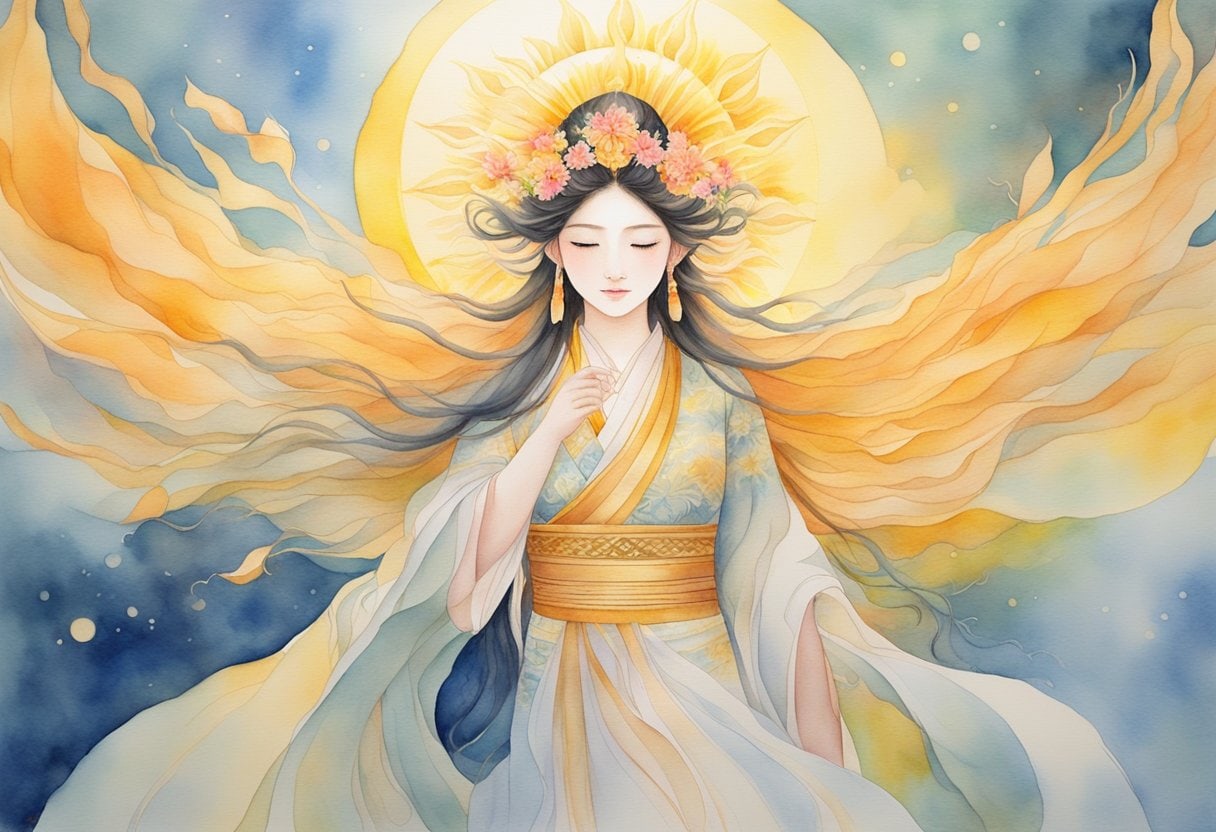
Amaterasu occupies a revered spot in Japanese mythology as the sun goddess who illuminates the world with her divine radiance. Revered across Japan, she’s not just another deity in the Shinto religion; she’s the queen of kami, making her influence immense and her lore rich with tales of celestial splendor. Her mythical origins trace back to being the daughter of creator gods Izanagi and Izanami, placing her in a lineage that commands the heavens and shapes the very core of Japanese spiritual belief systems.
Exploring the legend of Amaterasu is like unraveling the threads of Japan’s cultural fabric, where every tale reveals another layer of her significance. She’s believed to be the ancestor of the Japanese Imperial Family, lending her a status that intertwines the divine with the mortal dynasties of history. Sacred shrines dedicated to her, such as the Grand Shrine of Ise, act not only as places of worship but also as symbols of her lasting presence in the hearts of many. The rituals and festivals that pay homage to Amaterasu serve to connect the past with the present, ensuring her narrative is celebrated throughout generations.
Key Takeaways
- Amaterasu is Japan’s esteemed sun goddess and central to Shinto religion.
- Her lineage and mythos underscore her status as the progenitor of Japan’s Imperial Family.
- Shrines and cultural practices dedicated to her keep her story woven into the fabric of Japanese life.
[su_button url=”https://amzn.to/4iB8iJY” background=”#a62def” color=”#ffffff” size=”10″ icon=”icon: magic”]Shop Witchy Supplies[/su_button]
Mythical Origins and Family Lineage

Creation and Divine Parentage
Legend says Izanagi and Izanami, the deities charged with crafting the world, conjured the Japanese archipelago. In the celestial birthing room known as Takamagahara, or High Celestial Plain, these two spun the threads of creation. After a tragic descent to Yomi, the underworld, and Izanami’s subsequent death, a grieving Izanagi performed a purifying rite. Amaterasu, born from his left eye, was a radiant beacon, embodying the splendor of the sun itself.
The Celestial Siblings
As part of a divine trio, Amaterasu was one of three children born from Izanagi’s cleansing. Her brothers, Tsukuyomi, the moon god, and Susanoo, the tempestuous storm deity, complete the celestial family tree. Conflicts and harmony among them shaped the tapestry of mythical tales. Their interactions, especially between the sun and storm gods, represent the dynamic push and pull of nature’s forces.
Amaterasu and the Kojiki and Nihon Shoki Texts
The ancient texts Kojiki and Nihon Shoki preserve the lore of Amaterasu. They narrate not just her birth but also her central role as the ancestress of the Japanese Imperial Family. Within these pages, her lineage grants divine rights to emperors and establishes a spiritual narrative extending from the heavens to earthly governance. These stories, chronicled with reverence, affirm Amaterasu’s supreme status among the kami.
Sacred Artefacts and Shrines
The Imperial Regalia of Japan
Revered symbols of the Japanese monarchy, the Imperial Regalia, also known as the Three Sacred Treasures of Japan, have a mythical connection to Amaterasu. They consist of the Yata no Kagami (mirror), the Yasakani no Magatama (jewel), and the Kusanagi no Tsurugi (sword). Each represents a virtue: wisdom, benevolence, and valor respectively.
- Yata no Kagami: The sacred mirror is believed to lure Amaterasu out of her cave, restoring light to the world. It’s not just a mirror; it’s a symbol of truth, reflecting the soul.
- Yasakani no Magatama: The bejeweled necklace signifies the benevolence of the heavens, embodying the spirits’ connection to humanity.
- Kusanagi no Tsurugi: This legendary sword represents bravery and strength, often depicted in myths as a powerful force against evil.
These artifacts are so sacred that they’re only displayed during the enthronement of a new emperor and are kept hidden from public view, symbolizing the divine right of the imperial lineage.
Ise Grand Shrine: The Spiritual Home
The Ise Grand Shrine, also known as Grand Shrine of Ise, holds a special place in the hearts of many. It’s the spiritual home of Amaterasu and a stunning example of the connection between the deity and the imperial family. This shrine complex is so central that it’s rebuilt every 20 years according to Shinto tradition, representing the renewal of nature and the perpetuity of the Japanese spirit.
- Location: Nestled in the city of Ise in the Mie Prefecture, the shrine’s natural setting among tall cedar trees adds to its mystical aura.
- Architecture: Simple yet profound, the wooden structures adhere to ancient Shinto architectural styles, with an emphasis on harmony with nature.
The Ise Grand Shrine comprises two main shrines: the Inner Shrine, Naikū, dedicated to Amaterasu, and the Outer Shrine, Gekū, dedicated to the goddess of food, Toyouke. Amaterasu’s presence is strongly felt at Naikū, where the Yata no Kagami is said to be housed, making it a focal point for pilgrims seeking spiritual solace.
Influence on Culture and Worship
Festivals and Rituals
In Japan, several festivals celebrate Amaterasu, honoring her as the bringer of light and the embodiment of life-giving warmth. The most notable is the New Year festival, where people express gratitude for her illuminating presence. Shimenawa, sacred straw ropes, are often hung in her honor, symbolizing purity and the division between the physical and spiritual realms. Her influence is keenly felt in the ritual of Yukidaruma, where snowmen represent her power to melt away the snow, ushering in the spring.
Shinto Practices and Kami
Amaterasu is at the heart of Shinto practices, revered as a powerful kami (spirit or deity) who brings justice and the shining light to the land. Shinto shrines dedicated to her are scattered across Japan, most famously the Grand Ise Shrine, where she is enshrined as the “great kami”. Shrine maidens, known as miko, perform sacred dances called Kagura, which are believed to entertain the kami and bring blessings. The emperor of Japan is considered to be directly descended from Amaterasu, which solidifies the spiritual bond between the divine and the imperial family.
Amaterasu in Modern Japan
Amaterasu’s presence in modern Japan is not just historical; it shapes the cultural identity and moral foundation of contemporary society. She’s seen as the ancestral figure for the nation, and her legacy is embedded in everything from art to pop culture. Environmental initiatives often evoke her role as a protector of nature, underscoring her connection to agriculture and the sun. Through festivals, art, and daily worship, the spirit of Amaterasu endures, as does her message of peace and renewal.
[su_button url=”https://amzn.to/4iB8iJY” background=”#a62def” color=”#ffffff” size=”10″ icon=”icon: magic”]Shop Witchy Supplies[/su_button]
