
As you wander through Norse mythology you may encounter Jord, an earth goddess of profound significance. While she keeps a low profile compared to the likes of Thor and Odin, don’t be fooled; her role is as grounded as the earth itself. Think of her as the bedrock of the divine family tree – she’s the mother of Thunder himself, Thor, and her connections to other Norse deities weave through the ancient sagas like roots in the soil.
Jord is a figure shrouded in the mists of mythology, yet her presence is everywhere. Her very essence is the earth beneath your feet. Reflecting the raw beauty of the natural world, she symbolizes life’s enduring cycle. Even though you might not find her wielding a hammer or riding across the skies, her quiet power is in every grain of soil and in the strength of mountains. Her story interlocks with the Norse understanding of the world, reminding us that sometimes the most influential forces are the ones that don’t clamor for attention.
Key Takeaways
- Jord is an integral yet understated deity, embodying the earth in Norse mythology.
- Her lineage places her as Thor’s mother, showcasing her role in the divine hierarchy.
- Jord represents the perpetual cycle of nature, underscoring her subtle but vital influence.
Jord: Goddess of the Earth

Identity and Attributes
Jord, your quintessential Earth Goddess, is as old as the hills of the Norse cosmos. Her name itself means “Earth” in Old Norse, and she’s not a distant deity; she’s right below you, giving life to every forest, mountain, and meadow. Fertility courses through her essence—she’s the sacred soil from which life springs. Think of her as Mother Nature decked out in Viking garb.
In the sagas, you’ll find her mentioned as Fjorgyn, Hlodyn, or Jorth, a testament to her many sides, but one thing’s clear: she’s rock solid—literally. A powerful figure and a giantess by lineage, Jord is revered as the Mother of Thor, the god of thunder, which pretty much grants her superstar status in Norse belief.
Myths and Cosmic Role
Jord’s part in Norse mythology is like the steady drumbeat of the earth, mostly felt rather than heard. She might not snag the spotlight like some of the other gods, but she plays a pivotal role in the grand cosmic order. As the good ol’ Prose Edda and Poetic Edda lay out, this goddess doesn’t need chaos and adventure to prove her might—her strength lies in her steadfastness and the life that teems from her.
Think about this: without Jord, there’s no Thor—and let’s face it, Thor’s kind of a big deal. So next time you’re wandering through a forest or hiking up a mountain, remember: you’re in her realm, a sacred space of interconnectedness and divine majesty.
Genealogy and Divine Kin

Jord’s Divine Family
Jord, known as Jörð in Old Norse, meaning “Earth,” hails from a lineage both colossal and celestial. Your interest in Jord’s kin might stem from her most famous son, Thor, the god of thunder, whose father is Odin, the chief of the Aesir gods. This makes Jord a key figure in the divine hierarchy, linking the realms of giants to that of the Aesir.
| Family Member | Relation to Jord | Notable Attributes |
|---|---|---|
| Thor | Son | God of Thunder |
| Odin | Lover/Consort | Chief of Aesir |
| Nótt | Mother | Personification of Night |
| Anarr | Father | Lesser-known entity |
As a goddess born of the ancient race of giants, or Jötunn, Jord represents a natural force. She is sometimes also referred to as Fjörgyn, linking her to broader Earthly concepts and the fertility of the land.
Connections in Norse Pantheon
In the intricate web of Norse deities, Jord sits at a junction where the Aesir, rulers of the cosmos, merge paths with the elder Jötunn race. Although Jord doesn’t throw her weight around in myths like your usual god, her intimate ties with Odin and as Thor’s mom give her a backstage pass to some heavy-weight divine drama.
Your curiosity might be piqued by the connection these celestial beings share, reflecting the nuanced dynamics of Norse culture. The intermingling of Aesir and giants through Jord’s relations exemplifies the complexity of Norse divine relationships and the spectrum of power within their pantheon. It’s a family tree that doesn’t just branch—it weaves an epic narrative of creation and power, influencing the very fabric of Viking spirituality and storytelling.
Cultural Depictions and Worship

From Norse to Modern Perspectives
Your journey into Norse mythology takes you to ancient times when deities like Jord were not just legends but integral parts of daily life. Many gods had spiritual significance, but Jord’s role was quite unique. Earth herself, she was worshipped for her fertility and life-giving qualities. With roots likely branching into Indo-European traditions, her veneration might have shared similarities with earth worship in neighboring cultures, including Greeks and Romans, although there are no direct evidences of Jord being worshipped in these cultures.
Move forward in time, and you’ll notice how Christianity’s spread across Scandinavia led to a decline in the old religions. However, Jord’s essence, as the embodiment of the earth, seemed to transcend these religious shifts. Even though Norse culture did not survive in its original form, you’ll find echoes of its beliefs and rituals in modern appreciation for nature and in the artistic and literary tributes to figures like Jord.
Artistic Representations and Literature
As you wander through the galleries of history, artistic tributes to Jord might not be as plentiful as those for Odin or Thor, yet her influence is seen in various mediums. Think verdant landscapes in paintings and poems that hint at her nurturing power and steadfast presence. In literature, particularly skaldic poetry, Jord is mentioned, although her appearances are typically overshadowed by more active deities like Thor and Odin.
Skáldskaparmál, the Norse treatise on poetic language, references Jord in the context of kennings—creative metaphors used by the skalds. Here, she’s indirectly illuminated through poetry, yet remains a somewhat elusive figure. It’s as if she’s woven into the narrative fabric of the world itself. Even Eir, the goddess associated with healing, might have been invoked alongside Jord for her earthly connections to herbs and life. The subtlety of her presence in these cultural artifacts shows how you can still feel her significance without her being centre stage.
Symbolism and Influence Across Time
Nature’s Essence and Vitality
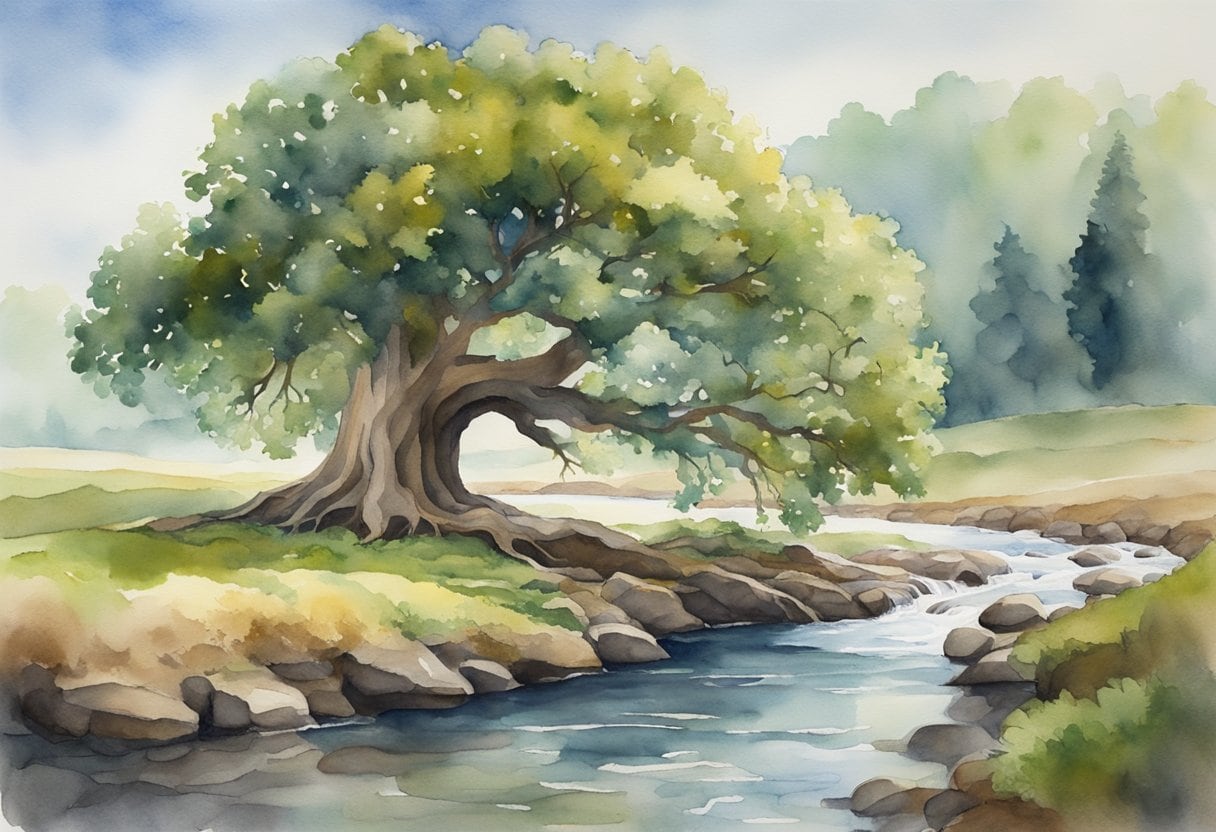
When you think about the Earth, what comes to mind? For the Norse, it was Jörd – an emblem of nature’s raw power and beauty. She’s the heart of every tree stretching upward to the sky and the strength found in the towering mountains. Her ties to natural abundance and the wilderness remind us of nature’s generous bounty. Every portion of the connected continuum, from the smallest blade of grass to the deep roots tapping into the Earth, bears her signature.
In harvesting seasons that come and go, the ancient folk saw Jord’s hands guiding agriculture’s success. Each grain and every crop reflected her sacred touch. Like the rhythm of life itself, Jörd stands as a symbol of what sustains us – a true celebration of life’s fold.
Eternal Legacy in Mythology
You’ve likely heard echoes of her legacy, whether through skaldic poems or whispers of her grandeur through the ages. Jörd’s tale winds its way through countless stories, traced through the veins of Norse mythology. Her influence is a tapestry interwoven with the mighty thunder god Thor, her celebrated son, and through her, the interconnectedness of all beings in the Norse pantheon.
Her story inspires even today, capturing imaginations and keeping the connections to the Norse gods alive. You can see her reflection in aspects of Greek mythology, as cultures find common ground in honoring the Earth. Jörd’s legacy, sacred and as old as time itself, continues to be a source of mystical inspiration and devotion within modern paganism and beyond.
