
Step into the ancient world, where legends unfold and deities reign supreme. In the Mesopotamian pantheon, a name that commands both respect and mystery is Ereshkigal, the Queen of the Underworld. Imagine a place where the departed spirits dwell, a realm far removed from the living—this is Ereshkigal’s domain, a divine ruler in a world beyond our own.
As ruler of the Underworld, Ereshkigal holds an esteemed position within Mesopotamian mythology and religion. Her stories are woven into the fabric of ancient literature, where she often appears as a central figure of power and authority. You’ll find her mentioned in myths such as “Inanna’s Descent into the Underworld,” showcasing her pivotal role in determining the fates of gods and mortals alike.
Key Takeaways
- Ereshkigal reigns as the powerful Queen of the Underworld in Mesopotamian mythology.
- She plays a crucial role in literature, epitomizing authority over life, death, and destiny.
- Worship of Ereshkigal included rituals and symbols, reflecting her broad cultural impact.
[su_button url=”https://amzn.to/3YfCaUX” background=”#a62def” color=”#ffffff” size=”10″ icon=”icon: magic”]Shop Witchy Supplies[/su_button]
Mystical Origins of Ereshkigal

Birth and Family Lineage
You’d be fascinated to learn that Ereshkigal’s roots are entwined with the primal forces of creation itself. Her grandfather, Anu, was the personification of the sky and the supreme deity of the Mesopotamian gods. Now, there’s a bit of family drama here — Anu’s daughter with Nammu, a primeval goddess, is none other than Ereshkigal, placing our underworld queen high up in the divine family tree. Imagine having such powerful figures in your family portrait!
Ereshkigal’s Domain in the Mesopotamian Pantheon
Let’s talk about where Ereshkigal fits in the grand scheme of things. She’s got the title “Queen of the Great Below,” ruling over Kur, the Mesopotamian land of the dead. This isn’t your average nine-to-five job. It’s a gig that involves keeping the departed souls in check and making sure the living don’t just waltz into her domain — pretty high stakes if you ask me. Ereshkigal shared this heavy responsibility with her husband Nergal, a god equally intriguing and fearsome, and together they ran the underworld like a well-oiled machine, balancing life, death, and the cosmic mysteries of Mesopotamia.
Ereshkigal in Mesopotamian Literature and Myth

The Descent of Inanna
Imagine a goddess daring to visit the shadowy realm of the dead. This is exactly what Inanna, the Sumerian goddess of love and war and Ereshkigal’s sister, does in the famous tale “The Descent of Inanna.” She embarks on a hazardous journey to the underworld, which is ruled with iron will by Ereshkigal. As you explore this poem, you witness Inanna stripped of her power and possessions until she stands bare before Ereshkigal. It’s a gripping story, showing the dynamic between celestial power and the sovereignty of the netherworld.
Ereshkigal’s Role in the Epic of Gilgamesh
Your next stop in the ancient scrolls is “The Epic of Gilgamesh,” a cornerstone of Sumerian literature. Ereshkigal’s presence is felt in the background when Gilgamesh, shaken by his friend Enkidu’s death, confronts the terrifying reality of mortality. Although not a main character, Ereshkigal’s domain serves as a chilling reminder of the afterlife that awaits all mortals. You see echoes of her power influencing key moments in this epic journey.
Hymns and Prayers to the Queen of the Great Below
Now, let’s softly chant the hymns and prayers that the ancient people of Anatolia might have whispered to honor Ereshkigal, paying respects to her dominion over the Great Below. It’s believed they appealed to her mercy and guidance, especially when faced with the enigma of death. You don’t find these pieces of devotion in every dusty tome, but where they do appear, they reveal a deep reverence for the Queen of the Underworld. You can almost hear their echoes through time, beckoning Ereshkigal’s favor or appeasing her tempestuous nature.
Rituals, Symbols, and Worship of Ereshkigal
Cult Centers and Temples
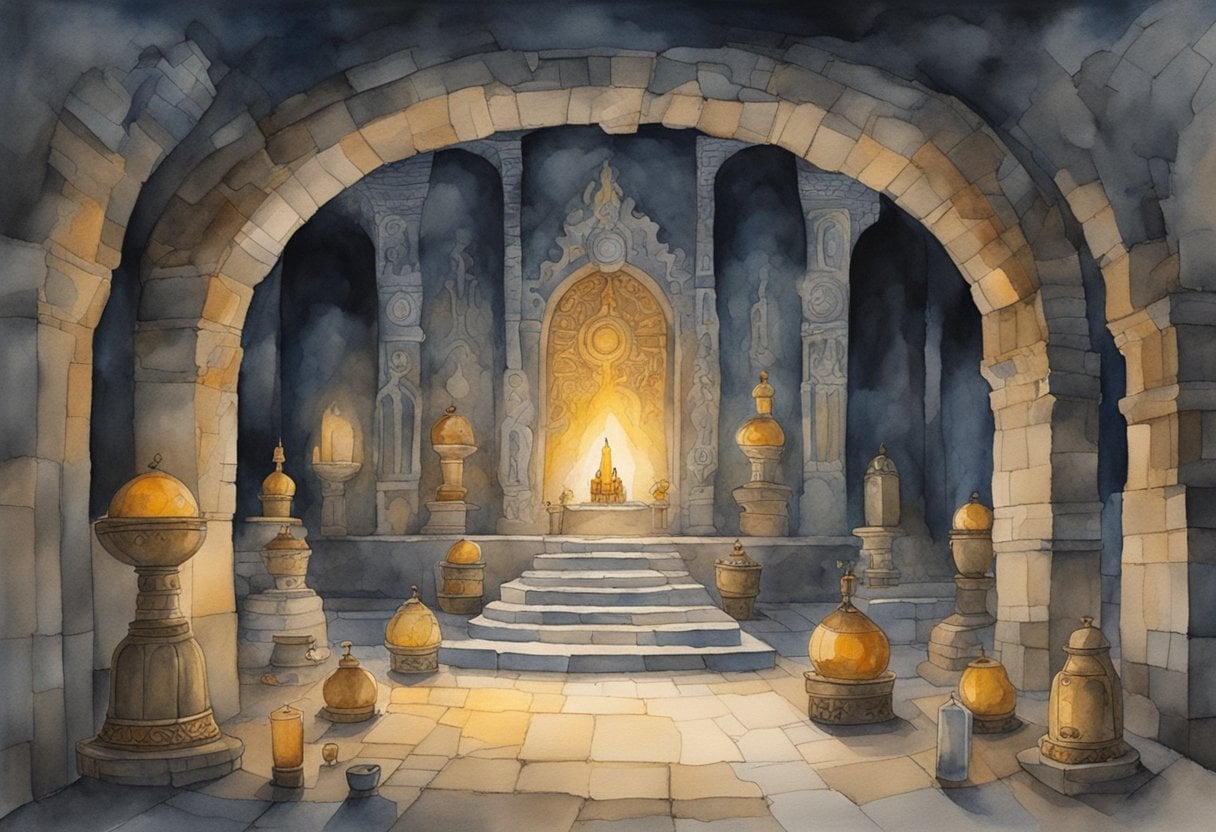
Kutha, known today as Cuthah, was a city sacred to Ereshkigal. It’s where her followers came together to honor the queen of the underworld. The city was a hub for those devoted to her cult, and it likely had a temple or a similar structure dedicated to Ereshkigal’s worship.
People back then would have performed ceremonies and rituals to propitiate the goddess, hoping to avoid her wrath or perhaps to gain her favor in matters of life and death. While specific rituals remain a mystery, you can imagine the fervor and solemnness as her devotees gathered within the temple’s hallowed walls.
Iconography and Depictions in Art
You might recognize Ereshkigal from the Burney Relief, also known as the Queen of the Night. This piece of art gives you a glimpse of how she was depicted thousands of years ago. With talons of a bird of prey, wings, and flanked by owls, this terracotta relief likely represents her commanding and complex nature.
Lions were another symbol associated with her, representing the goddess’s raw power and dominion over life and death. Artifacts and inscriptions often show these powerful beasts as a part of her iconography, reinforcing her status and might. So whenever you see these symbols, think of Ereshkigal and her mighty realm.
Ereshkigal’s Influence Beyond Mesopotamia
Comparative Mythology: Ereshkigal and Goddesses of Death
When you look at the myths around the globe, you’ll see Ereshkigal’s echoes in stories of other underworld goddesses. Greek Mythology talks of Persephone, a figure with a similar role, presiding over the afterlife alongside Hades. Like Ereshkigal’s dominion over the Mesopotamian netherworld, Persephone’s story also involves themes of death, renewal, and the changing seasons.
In Egypt, parallels emerge with the goddess Isis, who also ventures into the underworld in her narrative. While the details of their stories differ, their underlying roles reflect the universal human fascination with life, death, and what may lie beyond.
Moving over to Southern Arabia, the deity Atargatis holds significance in ancient religions, which shares a faint whisper of lineage traced back to the lore of powerful goddesses like Ereshkigal.
Ereshkigal’s Legacy in the Modern World
Fast forward to today, and you’ll catch glimpses of Ereshkigal’s legacy all around. Artists and writers draw upon her shadowy figure to craft narratives steeped in the essence of the underworld. She’s not just an old tale; her influence is stitched into the fabric of modern stories.
Her allure has a particular kind of gravity that pulls in those intrigued by the underworld’s mysteries. You see shades of her in novels, on canvases, in the chords of music, and throughout pop culture. Like a subtle undercurrent, Ereshkigal’s narrative continues to enrich our perception of afterlife myths and fuels imaginations worldwide.
[su_button url=”https://amzn.to/3YfCaUX” background=”#a62def” color=”#ffffff” size=”10″ icon=”icon: magic”]Shop Witchy Supplies[/su_button]
