
Lughnasadh, also known as Lammas, ushers in the harvest season, marking an occasion of plentiful bounty and communal sharing. Falling typically on the first of August, this date stands as a cross-quarter day midway between the summer solstice and the autumn equinox. It is one of the eight sabbats within the Wheel of the Year celebrated by Wiccans and other pagans, reaffirming a deep connection to the rhythms of nature. As the first harvest, Lughnasadh is rich with symbolism, celebrating the fruits of labors in the fields as well as in personal endeavors, reflecting upon the cycle of growth and the reaping of what has been sown both literally and figuratively.
The holiday honors the ebbing power of the sun as daylight starts to wane and the God in the mythos of the Wheel of the Year. The grain, cut down during harvest, is personified as the God, thereby infusing the festival with both joy for the harvest and the poignant recognition of the cycle of life, death, and rebirth. Traditions vary widely but often include the making of cornbread, the collection of herbs, and the offering of the first fruits as expressions of thanks for the abundance provided. This is a time of feasting, handfasting, and community gatherings; a period when individuals reflect on what they have accomplished and what is yet to come.
Key Takeaways
- Lughnasadh is a time to honor the harvest and marks the turning of the Wheel of the Year towards autumn.
- The festival celebrates the cycle of life and the fruits of personal and agricultural labor.
- Traditions include feasting, rituals of thanksgiving, and reflection on personal growth and achievements.
Historical Significance of Lughnasadh

Mythology of Lugh
The festival of Lughnasadh is named after Lugh, the illustrious Celtic sun god. He was revered as a deity of light and fire, whose lore paves the path of the holiday’s spiritual journey. Regarded as a divine patron of craftsmen and protector of the weak, Lugh’s mythology weaves a tale of dedication to the goddess Tailtiu, his foster mother. It is said that she exhausted herself to clear the plains of Ireland for agriculture. In honor of her sacrifice, Lugh inaugurated the festival.
Ancient Lughnasadh Celebrations
Originally, Lughnasadh was observed in Ireland, where the Gaelic people marked the beginning of the harvest season. They held gatherings at Tailte, near the modern town of Telltown, in memory of the goddess. These ancient celebrations were not mere festivity; they were a time for tribal reunions and the settling of disputes. Athletic competitions, feasting on the first fruits, and matchmaking were hallmarks of the traditional revelry.
Lughnasadh in the Modern World
As the wheel of time turned, Lughnasadh evolved while keeping its essence alive. Today, it symbolizes the first of three harvests and is celebrated by many around the world who follow the Wiccan and wider Pagan paths. Modern celebrants honor the spirit of the grain god with rituals of thanksgiving for nature’s abundance. They craft bread, partake in fairs, and perform ceremonies that echo the ancient customs, continuously breathing life into Lugh’s legacy.
Spiritual Meaning and Intentions
Significance of the Harvest
The harvest holds profound significance as it symbolizes the intricate dance between hard work and natural bounty. She, the diligent earth, presents her offerings in a grand display of golden grains, heralding a period of abundance. The harvest embodies the culmination of efforts and the generosity of nature, prompting a deep sense of gratitude among those who observe this sacred time.
Themes of Abundance and Gratitude
As the wheel turns, the air thrums with the energy of prosperity. To indulge in the themes of abundance and gratitude during Lughnasadh is to fill one’s heart with the myriad blessings that life bestows. Gratitude blossoms as the fruit on the vine, and individuals often manifest this sentiment by sharing their wealth, be it physical or spiritual, acknowledging the interconnectedness of all beings.
The Role of Personal Intentions
In this season, personal intentions are set with the hopes of weaving them into the fabric of reality, much like the careful gathering of wheat into sheaves. Intention acts as a powerful catalyst for change, an invisible force summoning the energy needed to turn the possible into the palpable. It is a time for individuals to survey the fields of their aspirations and, with careful hands, sow their desires into the rich soil of the present, trusting that in time, they shall harvest the fruits of their inner work.
Rituals and Practices

Setting up the Altar
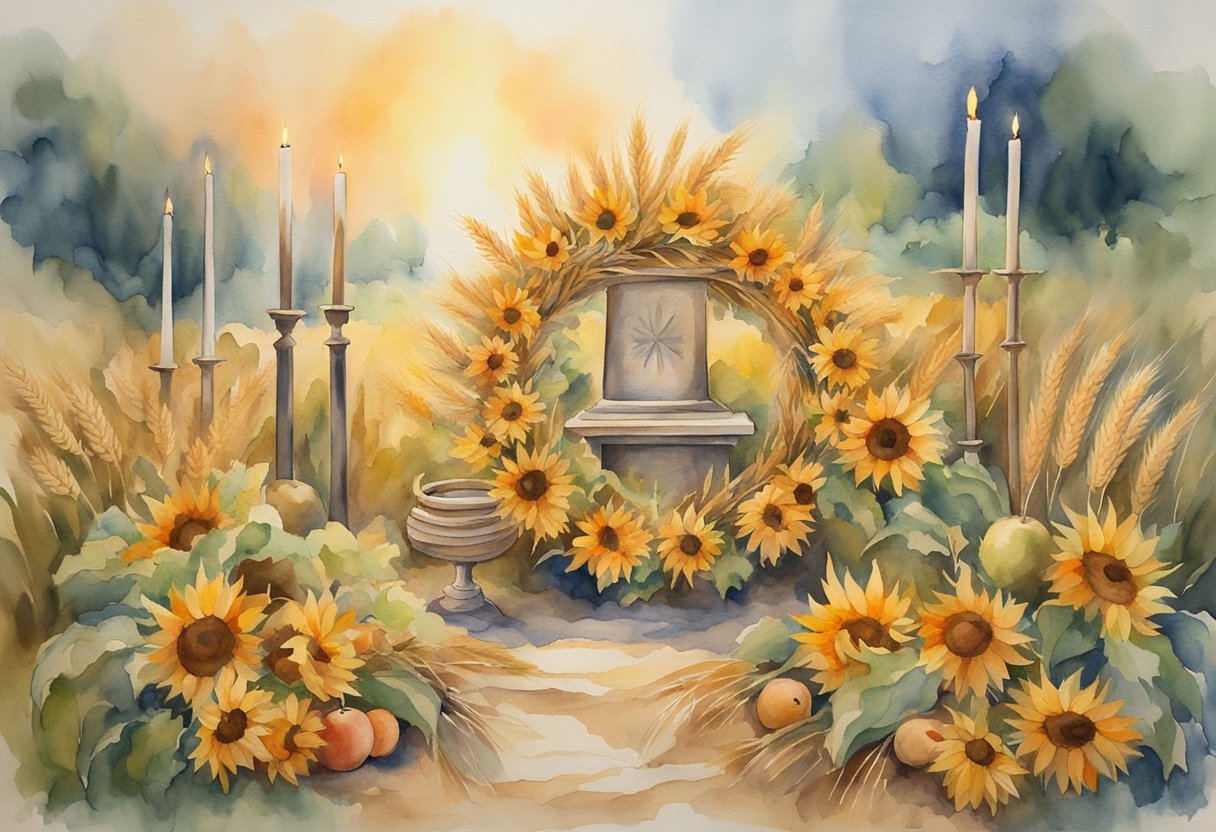
An altar acts as a focal point for Lughnasadh rituals, a sacred tableau reflecting the season’s abundance. They adorn it with grains, freshly baked bread, and summer fruits, honoring the generosity of the harvest. Candles flicker like the day’s lingering light, and incense weaves its fragrant whispers through the air, carrying intentions skyward.
Sacred Acts of Craft and Magic
In the heart of the celebrations, craft and magic intertwine. Spellwork and crafting amplify the holiday’s energy, as practitioners create talismans from sheaves of wheat or bake ritual breads infused with herbs. They may cast spells for abundance or perform rites to thank the deities, channeling the raw forces of nature to seed their intentions in reality’s fertile soil.
Communal Rites
Gathering in a circle, be it physical or of shared intent, the community strengthens its bonds. Spells are woven together, and the drum’s heartbeat anchors the rites. Magic radiates outward as the circle becomes a cauldron of communal energy, blending individual spirits into a potion of collective power, honoring the connection at Lughnasadh.
Symbols and Correspondences

Common Symbols of the Festival
At the heart of Lughnasadh are symbols that represent the onset of the harvest season. The corn dolly emerges as a poignant emblem, handcrafted from the first sheaf of grain, encapsulating the spirit of the harvest. Sun symbols and golden stones shimmer with associations to the sun’s peak strength, while the cauldron symbolizes abundance and transformation.
- Corn Dolly – Embodiment of the harvest
- Golden Stones/Sun Symbols – Tokens of the sun’s zenith
Colors and Their Meanings
As Lughnasadh paints the world with its hues, certain colors capture the festival’s essence. Gold gleams with the success of the crops and the sun’s lavish glow, while green reverberates with the life force pulsating through the ripe fields.
- Gold – Prosperity, sunlight, success
- Green – Vitality, growth, life
Crystals and Herbs as Tools
Crystals and herbs are the silent sentinels and whispers of intent during Lughnasadh. Carnelian, a sunset-hued stone, is said to fortify resolve and maintain the intrinsic fire of one’s spirit. The herbs of the season—grains that have reached their zenith, fruits pregnant with the promise of seeds—speak of cycles closing and new beginnings.
- Carnelian – Strength, courage
- Grains/Fruits/Seeds – Harvest, potential, renewal
Festivities and Customs

Traditional Games and Competitions
The emerald fields come alive as they play host to various traditional games and competitions. These physical challenges are not mere exhibitions of strength and skill but a vibrant homage to Lugh’s prowess and the spirit of the festival. Among the staple games, one may find spirited races and spirited wrestling matches, echoing the laughter and camaraderie of those who partake.
Music and Dance in Celebration
As dusk falls, music weaves its enchanting spell, filling the air with melodies that tug at the soul. Strains of the fiddle blend with the rhythmic heartbeat of the drum, inviting all to dance. These musical expressions are not just for entertainment but also serve as a bridge to the divine, allowing participants to immerse themselves in the spiritual essence of the Sabbat.
Sharing the Feast
The community gathers around the laden tables to share in the feast, a central and cherished tradition of Lughnasadh. Every morsel is a sensory delight, celebrating the earth’s generosity, from the golden sheaves of wheat to the ripe, sun-kissed grapes. In breaking bread together, they not only nourish their bodies but also weave the fabric of community tighter, with the shared meal symbolizing unity and gratitude.
Lughnasadh Foods and Recipes

Baking and Bread Traditions
The heart of Lughnasadh lies in the baking of bread, as grains like corn, wheat, and barley are harvested and transformed into loaves, symbolizing the spirit of the season. Bread-making during this time is both a ritual and a blessing—an act of turning the raw beauty of the earth into sustenance.
- Cornbread: A staple dish representing the sun’s energy, made from freshly milled cornmeal.
- Barley Cakes: Often sweetened with honey or fruits, embodying the sweetness of the harvest.
Seasonal Harvest Dishes
They relish the bounty of the harvest with dishes crafted from fresh, local produce. Vegetables and fruits such as summer squash, apples, and berries feature prominently on the Lughnasadh table, often paired with herbs harvested at their peak.
- Harvest Vegetable Stew: A melange of carrots, onions, mushrooms, and celery, simmering in a rich vegetable broth.
- Berry Cobblers: Desserts made from ripe blackberries, bilberries, and blueberries, hearkening back to woodland feasts.
Lughnasadh is more than a holiday; it’s the sacred interplay of sun, soil, and toil. Whether through the aroma of freshly baked bread or the vibrant hues of harvest dishes, the festival’s spirit is embraced in every morsel.
Lughnasadh in the Wheel of the Year
Understanding the Sabbats
The Wheel of the Year is replete with Sabbats—eight spiritual waypoints that punctuate the pagan calendar. They consist of four Greater Sabbats (Samhain, Imbolc, Beltane, and Lughnasadh) and four Lesser Sabbats (the solstices and equinoxes). Of these, Lughnasadh on August 1st is venerated as a time of thanksgiving and reflection upon the bountiful earth’s yield. The Sabbats are not just days, but waypoints that are tied deeply to the Earth’s cycles and agricultural affairs.
The Transition from Light to Dark
As Lughnasadh arrives, it heralds the sun’s gradual decline from its peak at Litha, the summer solstice, towards the balance of light and dark at Mabon, the autumn equinox. Days get perceptibly shorter in the Northern Hemisphere, where this harvest festival is a celebration of the generosity of the soil and a recognition of the need to prepare for the colder months ahead. In the Southern Hemisphere, the dates are mirrored, and Lughnasadh is observed around February 1st, connecting practitioners across the globe in a spiritual symmetry that honors the natural order.
Lughnasadh and Modern Practices
For Wiccans and many Pagans, Lughnasadh, also known as Lammas, heralds the first harvest of grains and the fading power of the sun deity. Marked on August 1st, this sabbat is celebrated as a time of thanksgiving for the abundance of the harvest. The modern witch might honor this period by preparing an altar with symbols of the season such as golden stones, harvest vegetables, and a loaf crafted from the first grains—tying them back to an ancient Christian tradition known as “Loaf Mass”.
In the contemporary Pagan community, Lughnasadh fosters a time for reconnecting with nature’s endless cycles. Ceremonies often involve crafting corn dollies or baking cornbread cupcakes, symbolically harnessing the spirit of the grain. They may share a chalice of apple cider in a circle, their hands clasped as they whisper thanks to the Earth.
The Lughnasadh rite may commence with the sweeping of a ceremonial area in a deosil (sunward) direction, signifying the beginning of a ritual with clear intentions. Those involved might light candles—gold to symbolize the god’s power at its peak and silver for the goddess witnessing the season’s transformation.
Rituals Performed:
- Gratitude: Reflecting on the wealth the Earth has provided.
- Bread-Making: Baking loaves signifies the “Loaf Mass” heritage.
- Altar Preparation: Adorning altars with harvest symbols.
- Candle Lighting: Gold for the sun’s energy, silver for the goddess.
This time of year, the community’s bond strengthens as they collectively acknowledge the turning of the wheel and the delicate balance between light and shadow. By the flicker of candlelight and the scent of summer incense, the season’s transformation is both observed and felt. Lughnasadh acts as a spiritual nexus, grounding participants in the wisdom of cycles that predate the stones and bones of this old Earth.
