Many along the meandering river of cultural practices struggle to differentiate between the terms “magic” and “magick.” At its core, the word “magic” conjures images of stage performers pulling rabbits from hats or wielding the art of illusion to dazzle an audience. It’s a term deeply engrained in mainstream entertainment, often associated with fictional wizards and whimsical spells in children’s fairy tales.
Conversely, “magick,” with its enigmatic final “k,” steps out from the shadows of the arcane, wearing the robe of the esoteric. This term was popularized by Aleister Crowley, a figure who stirs the cauldron of controversy with his occult practices. In his view, “magick” is the science and art of causing change to occur in conformity with will, a far cry from the sleight of hand associated with “magic.” This delineation firmly plants “magick” within the soil of the occult and spiritual, a seedling sprouting branches that reach into the realms of ritual and the harnessing of supernatural forces.
Origins and Etymology

Historical Development of ‘Magic’
The term magic derives from the Greek word “magike,” which implies a type of occult knowledge or practice. Historians chronicle that magic encompasses a spectrum of beliefs and rituals, anchored in the annals of human history. Its etymology snakes through ancient civilizations, such as the Persians, Greeks, and Romans, where magicians were practitioners believed to possess supernatural powers. Throughout the Middle Ages and into the Renaissance, magic continued to be associated with folklore, alchemy, and the esoteric arts, shaping its linguistic and cultural evolution in the English language. Notable figures in history, including scholars and self-professed magicians, have woven their influences into the fabric of its definition.
Aleister Crowley and the ‘Magick’ Definition
Conversely, the spelling magick, with a terminal ‘k’, was thrust into prominence by Aleister Crowley, a controversial and influential figure in the occult. Crowley specifically appended the ‘k’ to distinguish his practices and philosophy of thelema from mundane sleight of hand that performers practiced. He launched the term ‘magick’ in the early 20th century, and it has since taken root primarily within occult communities. Magick for Crowley was about harnessing the will to effect change; a disciplined pursuit rather than parlour tricks. It is tethered not just to his name, but also his legacy and works, such as “The Book of the Law” (Liber AL vel Legis).
Both magic and magick are storehouses of cultural and linguistic significance, each carrying their distinct pathways through epochs and lexicons.
Defining the Concepts

Understanding Magic
Magic is a term ensconced in the everyday vernacular, often draped in the cloak of entertainment and illusion. It refers to the art of producing effects or illusions perceived as impossible, either by sleight of hand or other forms of trickery—rabbits from hats, card tricks, and vanishing acts that ignite gasps and applause from an ensnared audience. The practitioners of this craft, magicians, weave their spells without the pretense of supernatural influence, instead relying on deft technique and psychological artifice.
| Aspect | Description |
|---|---|
| Primary Focus | Entertainment, Illusion |
| Key Elements | Sleight of Hand, Trickery |
| Practitioner | Magician |
Exploring Magick
Contrastingly, magick, with that telling ‘k’, steps beyond mere performance into the realm of the spiritual and the occultist. The word itself was revitalized by Aleister Crowley to signify the higher practice of the mystical arts—the harnessing of one’s will and intent through ritual to effect change in the material world. It’s a concept deeply intertwined with belief and often incorporated into the fabric of various esoteric traditions.
| Aspect | Description |
|---|---|
| Primary Focus | Spiritual Practices, Occult |
| Key Elements | Will, Intent, Ritual |
| Practitioner | Occultist, Spiritual Seeker |
For those whose curiosity is piqued, more details can be unearthed through reputable resources such as “The Hermetic Order of the Golden Dawn” and writings on Crowley’s Thelema. These accounts yield insights into the practice and philosophy underpinning the more recondite aspects of magick.
Practical Applications
Magic in Entertainment
Stage Magic shimmers with illusion and sleight of hand, captivating audiences in theaters and on television screens. Performers like David Copperfield and Penn & Teller have elevated it to an art form, with tricks ranging from the simple to the jaw-droppingly complex. A traditional magic show might feature card tricks, escape acts, or transformations, all accomplished through a skillful combination of props, distraction, and manual dexterity. In this world, the purpose is to entertain, to create a sense of wonder, and to (perhaps momentarily) suspend disbelief.
- Key Tools:
- Cards
- Coins
- Ropes
- Boxes
- Popular Techniques:
- Misdirection
- Optical illusions
- Mechanical devices
- Famous Venues:
Magick in Spiritual Practice
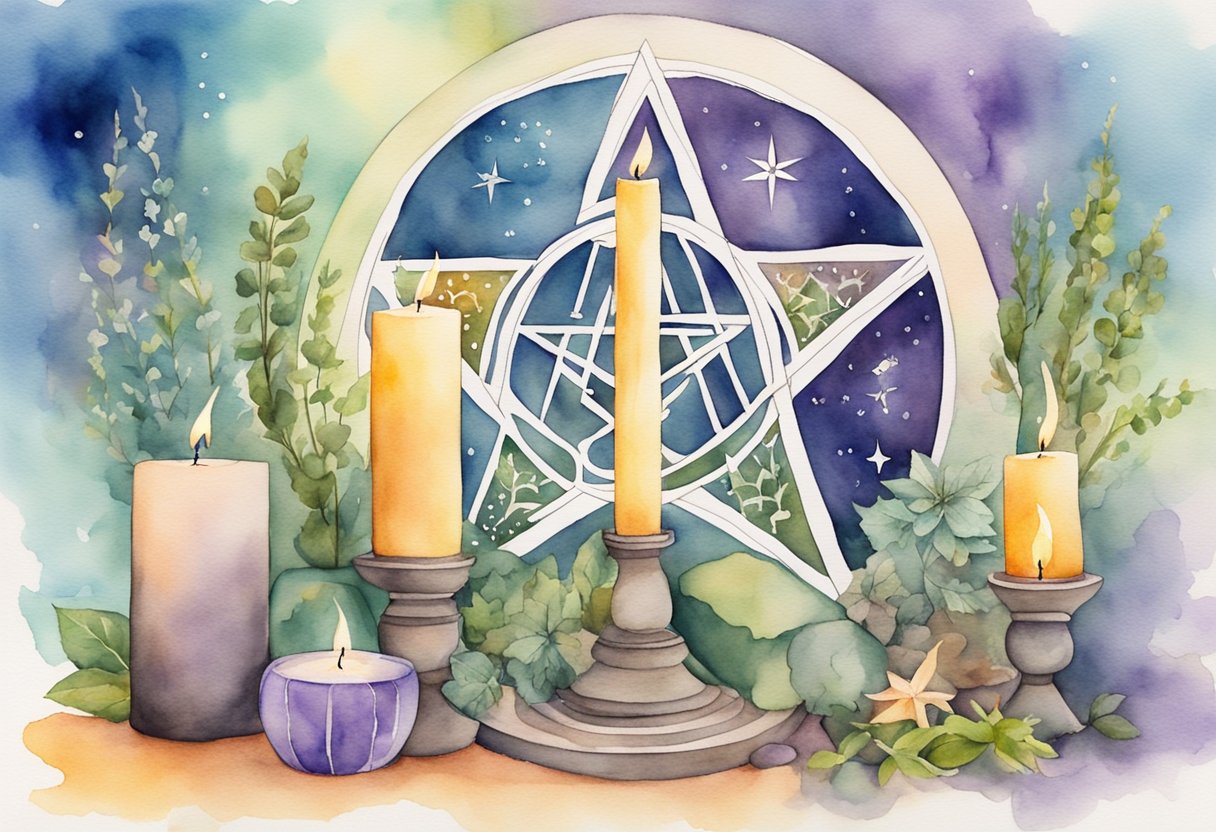
Conversely, Magick is rooted deeply in spiritual practice and the pursuit of esoteric knowledge. Those who tread this path engage in rituals aimed at manifesting their intentions and for advancing spiritual growth. This practice often involves the serious study of magickal systems, such as the Hermetic Order of the Golden Dawn, and the application of this knowledge in a disciplined manner. Supporters believe that through precise ritualistic work — embracing symbols, spoken words, and ceremonial tools — individuals can tap into unseen forces and bring about change in accordance with their will.
- Core Elements:
- Symbols
- Mantras
- Energy manipulation
- Common Tools and Practices:
- Candles and incense
- Crystals
- Tarot cards
- Astrological alignments
- Practitioners may study texts from:
- Aleister Crowley: Writings
- Dion Fortune
Magick’s purpose diverges sharply from entertainment; it’s focused on personal transformation and the exploration of unseen realms. Whether through solitary work or in a group, magick in theory and practice is at its core a deeply individual journey.
Cultural and Social Context

Magic as Performance Arts
The art of illusionism is a crowd-pleaser, where a magician may pull rabbits from hats or make cards disappear. This facet of magic is entrenched in performance, delighting audiences with deception that openly acknowledges it is just for show.
- Supernatural: Not truly at play here; the feats are skill-based illusions.
- Entertainment venues: Theatres, television programs, and street performances.
- Famous practitioners: Harry Houdini, David Copperfield, and Penn & Teller.
Magick in Occult Communities
Conversely, ‘magick‘ claims to tap into the metaphysical and esoteric. This is the realm of occult communities, where witchcraft and other practices are approached with grave earnestness, as a means to manipulate hidden forces.
- Hidden knowledge: Symbolism and rituals are employed to access deeper truths.
- Spiritual or religious contexts: Often part of pagan, Wiccan, or thelemic ceremonies.
- Notable figures: Aleister Crowley ({Magick in Theory and Practice}), Dion Fortune.
Impact on Contemporary Society

Public Perception and Influence
In the realm of public perception, Magic conjures images of illusionists and entertainers performing sleight of hand and misdirection. These performers dabble in tricks and illusions that delight audiences worldwide without claiming any genuine supernatural powers. Society often views Magic within a framework of entertainment, celebrity magicians like David Copperfield and Dynamo enhancing its glamorous allure. On the flip side, Magick is steeped in the mystical, symbolizing a more serious undertaking that edges toward the realms of the occult. Practitioners of Magick—with that pivotal “k”—engage in rituals and ceremonies grounded in belief systems that assert influence over the material world through supernatural or metaphysical means.
The threads of occultism and sorcery, tied closely with Magick, weave through the fabric of social groups dedicated to these mysterious arts. The confluence of divination, astrology, numerology, and Magick enriches various subcultures and influences personal practices. Furthermore, the fluid intersection with religion highlights how these practices often serve as spiritual paths for seekers dissatisfied with conventional faith avenues. Folklore and myth, meanwhile, shape how both forms of magic are integrated into literature, cinema, and digital media.
Adaptation and Evolution Through Time
As centuries roll by like an unforgiving tide, Magic and Magick have adapted and morphed, reflecting an age-old dance with cultural evolution. Initially, the terms Magic and Magick were virtually indistinguishable in the cauldron of history. However, it was the early 20th-century esoteric traditions, notably those of Aleister Crowley, that intentionally branded “Magick” with a “k” to distinguish the ceremonial and occult practice from stage magic.
Occult practices have transitioned from the shadows of persecution to the light of curiosity and academic study, maintaining a place in contemporary spirituality and alternative philosophy. In stark contrast to this mystical reverence, Magic as entertainment has enjoyed a rather consistent and cheerful melody, enchanting generations from medieval market squares to modern televised talent shows. As society sprints into an increasingly digital era, both Magic and Magick hold their ground, evolving with innovations such as online tarot readings and virtual magic performances, perpetually reinventing the ancient to fit the newborn whims of today’s interconnected globe.
