
Imagine stumbling upon a relic of a rich, mystical past, where enigmatic deities once bridged the human and the divine. The goddess Nehalennia is one such enigmatic figure, intimately tied to the Celtic and Germanic tribes of old, yet also embraced by the Romans during their time in the Netherlands. She’s a bit of an enigma—did she start out Celtic and swing over to the Roman pantheon, or was it the other way around? The mystery only adds to her allure.
Now picture a seaside sanctuary, the briny air filled with whispers of devotion and the secrets of sea travelers who revered Nehalennia for protection on their voyages. Her story is pieced together from relics found mostly in the province of Zeeland, where the ancient Schelde River meets the North Sea. Inscriptions and altars dedicated to Nehalennia offer a glimpse into the past, revealing how she was honored and beseeched for safe passage and bountiful harvests. She’s a tapestry of cultural threads, each one showcasing the fusion of beliefs and practices that colored the spiritual landscape of the region.
Key Takeaways
- Nehalennia is a mysterious figure with Celtic and Germanic ties, later associated with Roman pantheon.
- Her worship was centered around trade, seafaring, and fertility, as evidenced by altars and inscriptions in the Netherlands.
- Cultural synthesis is reflected in her veneration, showing how different traditions merged in ritual and belief.
[su_button url=”https://amzn.to/3YfCaUX” background=”#a62def” color=”#ffffff” size=”10″ icon=”icon: magic”]Shop Witchy Supplies[/su_button]
The Legend and Worship of Goddess Nehalennia
Origins and Historical Significance
You may wonder where Nehalennia first sprang from, as her origins are shrouded in time. Evidence suggests she was venerated in regions spanning Belgium, Germany, and the Netherlands, scribblings hint at Celtic influences. Though her name peppers inscriptions dating from at least the 2nd century BC, connecting her to the Roman era, you’ll find historians still squabble gently over whether she’s more Celtic or Germanic at heart.
- Primary Role: Protector of seafarers and traders
- Geographical Spread: Worship centered in Zeeland, the Netherlands
- Cultural Integration: Germanic and Celtic influences merged during Roman times
Symbols and Iconography
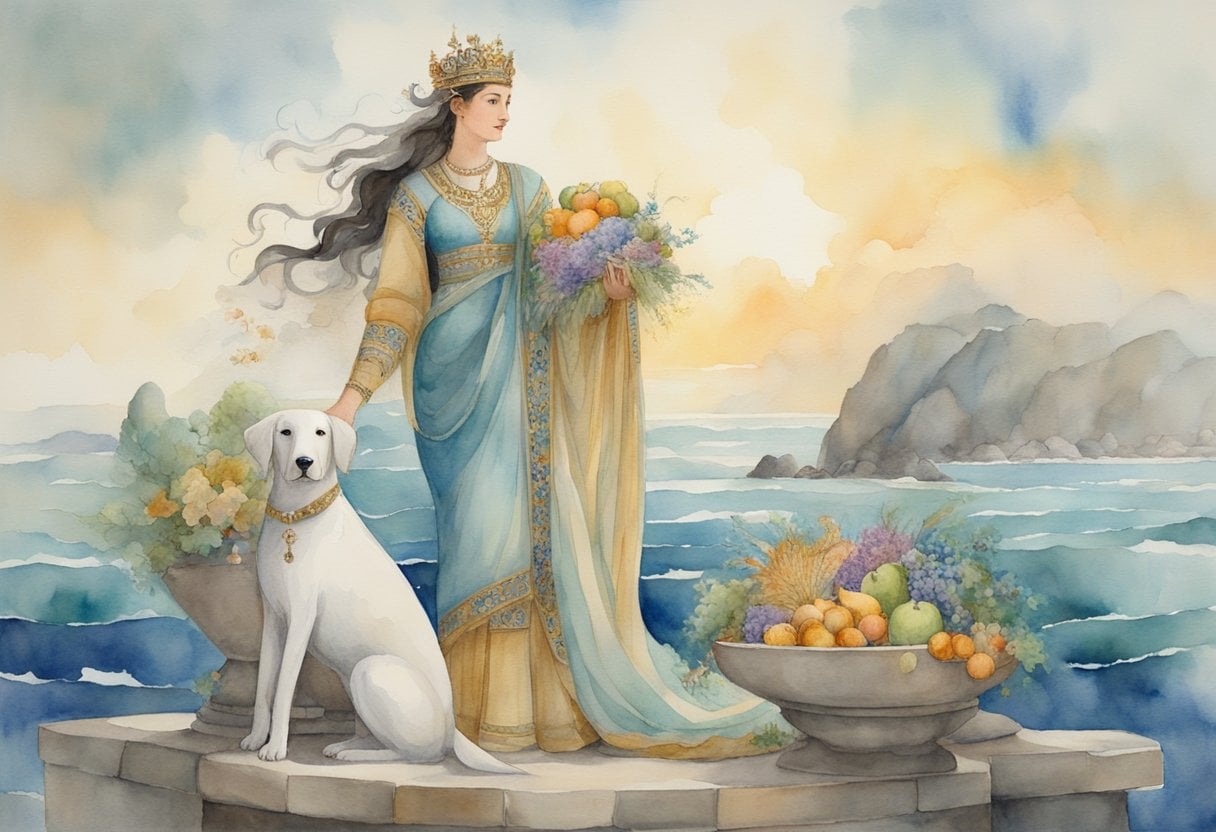
Imagine you encounter Nehalennia; you’ll likely catch her with a loyal dog by her side, signaling her protective nature. A basket of apples she cradles may signify abundance and fertility, while the backdrop of marine symbols ties her to the sea. Often depicted on votive altars, these icons help decode her storied past and the rich tapestry of lore woven around her.
- Nehalennia’s constant companions:
- Dog: Loyalty and protection
- Basket of Apples: Fertility and abundance
- Boat/Ship: Safe passage and connection to the sea
Sacred Sites and Temples
Your spiritual journey could lead you to Colijnsplaat or Domburg, both in the Netherlands, where Nehalennia’s presence was once palpable at devoted temples. At these sacred sanctuaries, pilgrims and worshippers would offer altars out of reverence, imploring her guardianship. Even today, these sites pull at the threads of memory, binding you to a world where divine and human once intimately entwined.
- Notable sacred sites:
- Temple at Colijnsplaat
- Temple at Domburg
- Votive altars: Markers of reverence and requests for protection
Cultural and Religious Synthesis

Integration of Celtic, Germanic, and Roman Elements
Nehalennia, your mysterious deity, seems to wear many cultural hats. Originating in a region soaked in both Celtic and Germanic influences, experts suspect that she might initially hail from one, then later blended with the traits of the others. Celtic Origin likely gives her that mystical allure you associate with druids and dark forests. Over time, the Roman Empire left its mark too, as it did with many European traditions, integrating Nehalennia into their pantheon, adding a classic Roman spin to her worship. Altars and inscriptions dedicated to her, found in the Netherlands, are etched with both Celtic scripts and Roman designs, revealing a religious Syncretism that tells a tale of peaceful coexistence and mutual respect between cultures.
- Celtic: Connections to maritime safety and fertility
- Germanic Deity: Associations with trade and prosperity
- Roman Empire: Elements contributing to the architectural and epigraphic style of her shrines
Goddess Nehalennia in Modern Time
Fast forward a couple of millennia, and you’ve got a Resurgence of Interest in Nehalennia, especially in the places she once called home—Germany, Belgium, and the Netherlands. Her story, almost swallowed by the sea and time, now rides a wave of renewed fascination. In part, thanks to pop culture romanticizing ancient times, she’s receiving a fresh batch of love and attention, prompting a modern-day appreciation of her history and significance. Here’s what’s happening with Nehalennia today:
- Renewed Interest: A cultural revival, sparking academic studies and local tourism
- Modern Influence: Symbolic representation of regional identity and heritage
Influences Beyond Borders
Maybe it’s her air of mystery, but Nehalennia’s reach isn’t confined to where historians once found her altars. Your goddess has traced spiritual lines to England and beyond, captivating hearts with her protective embrace. She shows you how ancient beliefs aren’t just historical footnotes. They travel, transform, and touch lives far from where they first blossomed.
- Beyond Belgium, Germany, England: Inspirations for art, literature, and neo-pagan practices
- Global Connection: Part of a larger network of ancient goddess worship remembered and revered in various cultures
As you see, Nehalennia’s essence is a mingling of paths crossed and stories shared. It’s about how different folks came together, offering their myths and gods to one another, creating something enriched by all.
Rituals and Offerings

Votive Practices and Sacred Offerings
When you think about ancient rites and dedications, picture traders and sailors offering thanks for a successful voyage or asking for protection on an upcoming journey. Listed amongst the gods, Nehalennia was special to these groups, honored for her safeguarding powers. At her altars, evidence of gratitude came in the form of carved stone altars, usually inscribed with the donator’s name, showcasing a sort of fidelity between the goddess and her worshippers. Common goods placed upon her altars included fruits, which symbolized fertility, and loaves of duivekater, a sweet bread often used in sacrifices to deities for the prosperity and safety of trades and travels. If you were a part of that era, you might have also laid down tokens that bore her imagery alongside dogs, perhaps indicating the canines’ significant but now obscured ritual role.
The Role of Nehalennia in Nautical Ventures
There’s a sense of mystery when it comes to the ocean, and for those ancient seafarers, having Nehalennia on your side was like possessing a talisman against the unpredictable nature of the tides. Her prominence as a Mother Goddess – a figure embodying the Matronae – was evident in inscriptions found not just on altars but also on ship remains, venerated for her role in protection, travel, and trade. Physical embodiments of her watchful gaze could be found in the form of figurines on ships. Your passage over the sea would’ve likely felt more assured as her presence whispered promises of safe travels and the prosperous exchange of goods through the treacherous waters.
And so, in your dealings with the sea, your reliance on divine favor from Nehalennia was as substantial as your ship itself. Your offerings and rituals would be more than mere tradition; they were an intimate dance with the divine, seeking favor and expressing unwavering gratitude.
[su_button url=”https://amzn.to/3YfCaUX” background=”#a62def” color=”#ffffff” size=”10″ icon=”icon: magic”]Shop Witchy Supplies[/su_button]
