

Imagine stepping back in time to the world of ancient Greece, where the crackling of a hearth fire was the heartbeat of every home. This was the domain of Hestia, the Greek goddess of the hearth and home. She held a space of honor in the Greek pantheon, safeguarding the flame that provided warmth and unity to families. Unlike her more boisterous siblings Zeus and Hera, Hestia was known for her gentle demeanor and commitment to domesticity, embodying the tranquility of household life.
As a virgin goddess, Hestia took a vow of chastity, which was a significant choice in the lives of Greek deities. This decision linked her to concepts of purity and peace, setting her apart from the often chaotic and dramatic mythological narratives that surrounded her family. Her worship was less about altars and temples and more about the simple act of maintaining the family hearth. Honouring Hestia was part of everyday life for ancient Greeks, making her an omnipresent deity in the home.
Key Takeaways
- Hestia is the Greek goddess of the hearth, home, and domesticity, embodying peace and stability.
- She is known as a virgin goddess, reflecting her purity and commitment to the sanctity of the home.
- Worship of Hestia was deeply rooted in daily life, with her presence felt in every maintained hearth fire.
[su_button url=”https://amzn.to/3YfCaUX” background=”#a62def” color=”#ffffff” size=”10″ icon=”icon: magic”]Shop Witchy Supplies[/su_button]
Mythological Origins and Family Lineage

Early Life and Birth
You might wonder how Hestia came to be. Cronus and Rhea, her parents, were Titans of extraordinary power. Her inception was anything but ordinary, considering that Cronus was paranoid about being usurped by his kids. So, he did the unthinkable — he swallowed his children at birth. But Hestia wasn’t alone in this cold, dark, internal ‘prison.’ Her siblings were right there with her: Demeter, Hera, Zeus, Hades, and Poseidon.
It was through quite the twist of fate that they were all freed when Zeus, the youngest brother, tricked Cronus into regurgitating his immortal offspring. Your image of family drama has nothing on this tale of celestial cunning and gastric reversal.
Siblings and the Olympian Pantheon
Once Hestia and her siblings were liberated, they became the core of the Olympian Gods. Off she went to Olympus, where she found her place among her siblings and other Greek Gods. Her brother Zeus became the king of the gods, brother Poseidon snagged the sea, Hades ruled the underworld, Hera became Zeus’s wife and queen, and Demeter took up the mantle of agriculture.
Hestia chose the hearth, becoming synonymous with home and sanctuary. There was no sibling rivalry for this role — it seems like she wanted a gig that let her keep the peace. She’s the big sister who didn’t just watch the divine drama unfold but in fact, played a critical role in holding the family and Olympian order together.
Role and Worship in Ancient Greek Religion

Protector of the Sacred Hearth and Family
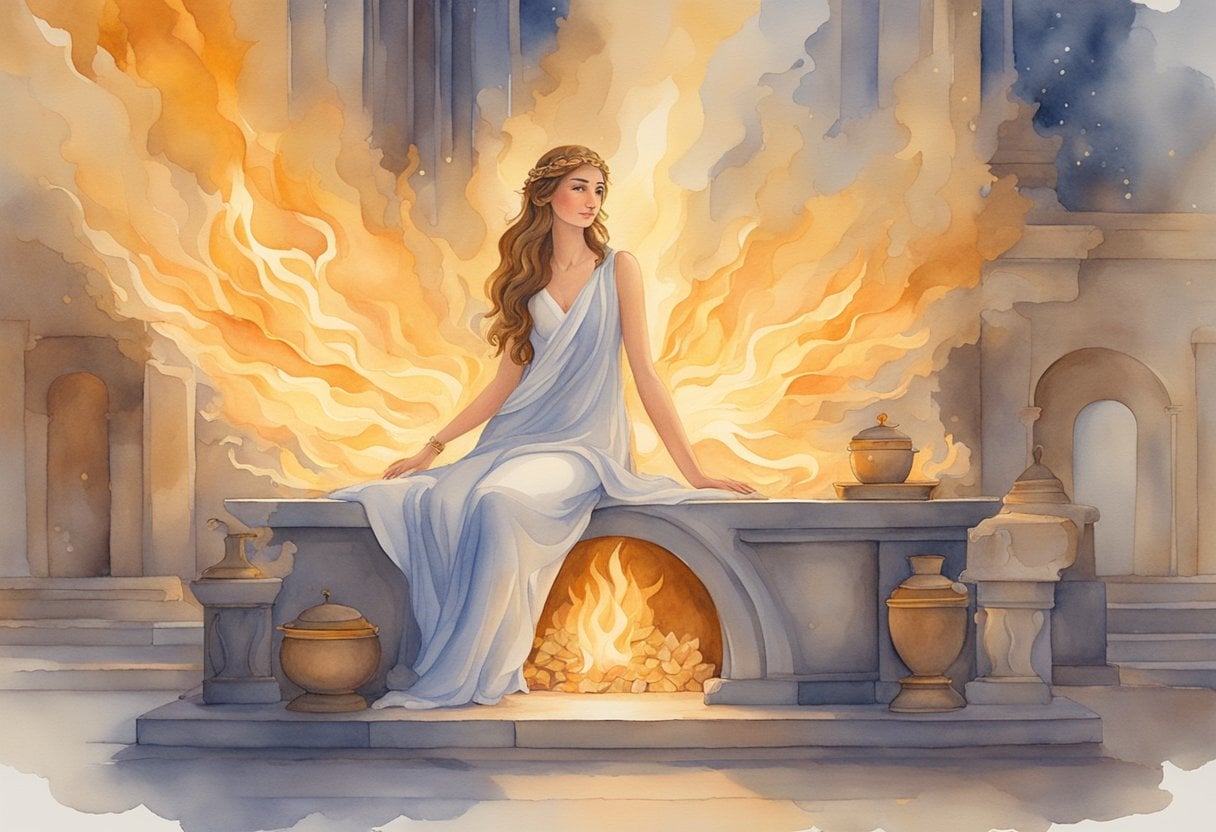
In the heart of every Greek home burned the hearth’s fire, a flickering symbol of Hestia herself. Virgin and pure, she stood for the unbreakable bond of family and the warm embrace of domestic life. You’d find no temples towering in her honor; Hestia’s shrine was the hearth itself, where the eternal flame served as a visual hymn to her presence and power.
Temples and Offerings
Though Hestia’s presence was felt in every home, she did have her public sanctuaries known as Prytaneia. Here, Hestia watched over the communities, safeguarding the unity and continuity of the city’s life. Offerings to her were simple yet profound, like a portion of the day’s meal or a share of the sacrifices to other gods, as she partook in all sacrifice within the Greek religion.
Rituals and Festivities
Your life as an ancient Greek would have been laced with rituals dedicated to Hestia, each as measured and full of reverence as her serene nature demanded. Starting any ritual or festivity, the first libations poured and the first prayers offered were always for Hestia, ensuring her blessing rested upon all proceedings. Hymns floated on the air during her feasts, spinning an aural tapestry as intrinsic to worship as the flames upon her altar.
Symbolism and Influence on Culture
Fire as a Symbol of Home and Community
Your ancestors would gather around the hearth, where the fire roared, not just for warmth but for togetherness. The hearth, presided over by Hestia, was more than a mere fireplace; it was a communal point where stories and bonds were as warm as the flames. Every home’s fire was a spark from the public hearth, bridging the gap between the private sanctuary and the bustling life of the city-states.
Literary References and Artistic Depictions
You’ll see Hestia in the backdrop, rarely at the center stage of myths, yet her presence is felt in every household’s mention. Artists portrayed her as a modest woman, a virgin goddess, embodying domestic harmony and shunning the tangles of war and marriage. You won’t find many statues, but her essence lingers in the literary nods to the role of fire and hearth in ancient Greek tales.
Role in the Foundation of City-States
When you think of city-states and their strength, imagine the central hearth where Hestia’s fire burned eternal. This flame not only warmed bodies; it symbolized the heart of political and social unity. As you partake in community rituals, you’re touching on an age-old practice of protecting the sacred fire, a duty that linked the essence of Hestia to every founding and functioning aspect of the cities you know.
Hestia’s symbolism runs deep, her influence resonating in the core of what it meant to be part of a community and a civilization. From her eternal fire to her quiet strength, she’s there in every notion of home.
Legends and Myths of Hestia
The Tale of Hestia’s Eternal Virginity
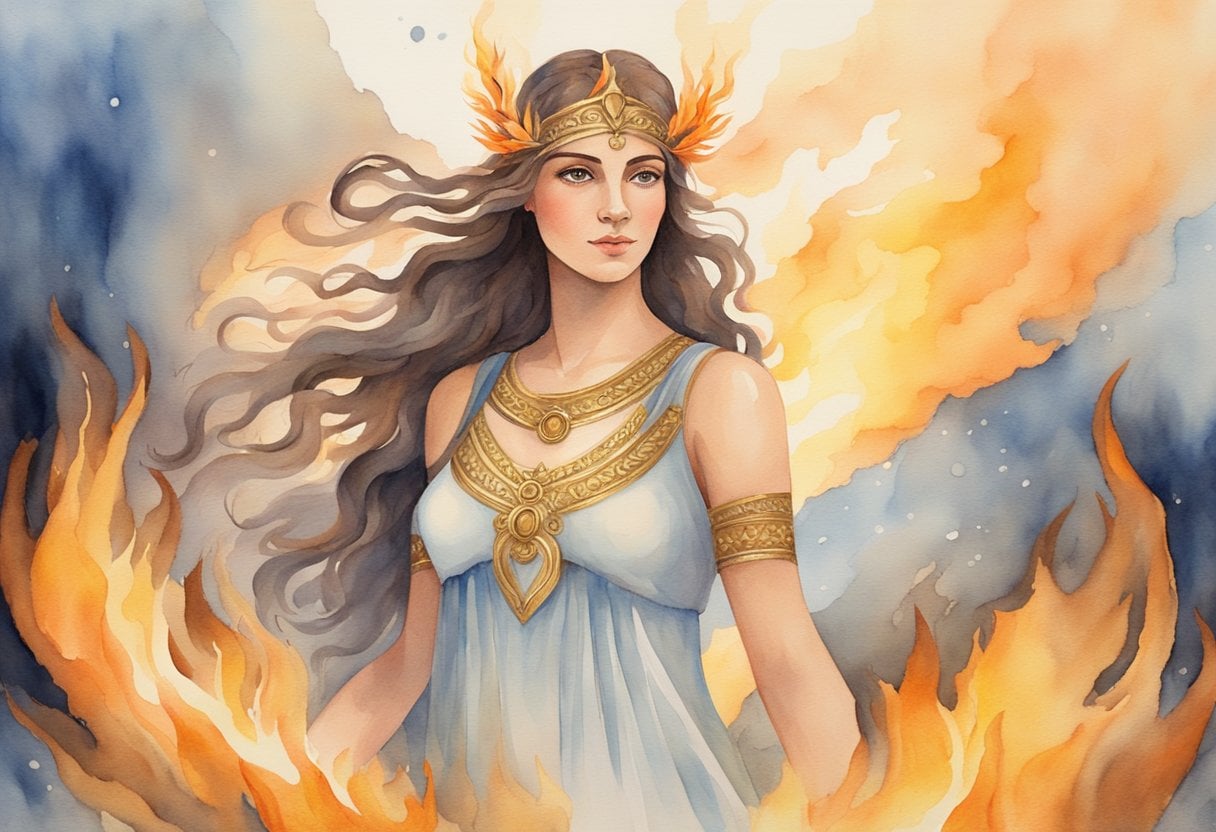
You’ve probably heard of deities making big promises, but Hestia’s vow of eternal virginity is quite the standout. Homer and Hesiod give us the lowdown in texts like the “Theogony.” She was courted by gods like Poseidon and Apollo but chose to remain unattached, dedicating herself to the hearth. This wasn’t just about steering clear of romantic entanglements; it was Hestia’s way of keeping the home fires burning for the gods and mortals alike.
Apollo and Poseidon respected her choice, leading to a peace among the deities that was rare in the often tumultuous world of Greek mythology. Reflect on that—how often do you hear about calm resolutions among these godly beings?
Interactions with Other Deities and Mortals
So, how did Hestia get along with others? Exceptionally well, considering she was all about the homefront and hospitality. There’s a curious myth involving Priapus and a donkey, where her chastity was nearly compromised. Thankfully, the braying of the donkey alerted her to Priapus’s advance, and she was spared.
Besides that close call, Hestia was the go-to deity for anything hearth and home. That meant serving as a silent witness to all that unfolded within the domestic sphere, from family disputes to the welcoming of guests. Her presence was so crucial that she was honored with the first portion of food and wine, and she was considered the deity you’d chat with to ensure warmth and safety in your home.
Food, wine, olive oil—you name it, and it was likely dedicated to Hestia in some way, as a token of reverence and a nod to her role as the keeper of the sacred flame. Remember, while times have changed, those ancient flames of the hearth still symbolize the nurturing warmth that feeds both bodies and spirits.
[su_button url=”https://amzn.to/3YfCaUX” background=”#a62def” color=”#ffffff” size=”10″ icon=”icon: magic”]Shop Witchy Supplies[/su_button]

Thank you for the information 💞💫