
Wicca and Paganism are often intertwined in public conversation, yet they branch from distinct spiritual roots that extend deep into the rich earth of history. Like two trees in an ancient, sacred grove, they grow from the same ground of nature-based reverence but reach toward the heavens with their own unique set of beliefs, rituals, and practices. Wicca, introduced to the public in the 1950s by Gerald Gardner, presents itself as a modern interpretation of witchcraft, though there remains a spirited debate about its direct lineage to the practices of ancient times.
Within the wide embrace of Paganism, Wicca finds its space, being one newer leaf on an evergreen tree with roots stretching back to civilizations long gone. Paganism serves as an umbrella term that captures a multitude of spiritual paths, each celebrating the divine in their varied polytheistic and nature-centric ways. Still, not all who walk Pagan paths identify as Wiccans, for Paganism is a panorama of spiritual diversity, encompassing traditions from Norse Heathenry to Hellenism and beyond—each with their own cosmologies and worldviews.
Key Takeaways
- Wicca is a distinct practice of modern witchcraft with its own set of beliefs and rituals, often associated with duotheism.
- Paganism is an expansive term that includes many religious traditions, with Wicca being just one among them.
- Both Wicca and Paganism share a reverence for nature and the cyclical patterns of life, although their expressions in worship and belief may differ.
Historical Roots
Ancient Practices
Before the rise of monotheistic religions like Christianity, polytheistic worship of various gods and goddesses flourished across Europe and Asia. These ancient peoples—whether they were Greeks, Romans, or belonging to lesser-known cultures—celebrated a variety of rituals and held sacred the many facets of nature and divinity. They lived attuned to the earth’s rhythms, venerating deities that governed the skies, the harvest, and the mysteries of life and death. Such practices and beliefs, considered pagan in a historical context, stood as the norm before Abrahamic religions started to dominate the spiritual landscape.
Modern Revival
In the 1950s, Gerald Gardner introduced Wicca to the public eye, heralding a neopagan revival. His presentation of Wicca asserted a continuity with the witchcraft of ancient times, although this direct lineage remains the subject of debate. Gardner brought structure and formality to Wiccan practice, emphasizing the worship of both a Goddess and a God, and the significance of magical rituals. As time progressed, various traditions have emerged, including the eclectic witch path, characterized by individualized practices that draw from diverse sources. This modern adoption and adaptation signify a rekindling of interest in pre-Christian spiritualities, creating a new branch on the ancient tree of pagan belief systems.
Core Beliefs and Practices

Theological Structures
In the garden of polytheistic traditions, Paganism blooms with a variety of deities, where divine power flourishes in the many petalled faces of gods and goddesses, resembling the diverse foliage of the earth itself. This spiritual ecosystem acknowledges the existence of multiple deities, each with their own realm, be it the moon, the air, or the sun. In contrast, Wicca often circles around a dual-theistic structure, venerating both a Goddess and a God, who symbolize the balance and harmony of nature’s dualities, much like the dance of fire and water under moonlight.
Ritual and Magic
Delicate threads of intention weave through the loom of Wiccan and Pagan practices, crafting rituals and magic as expressions of faith and instruments of change. They share common tools like the pentacle, a symbol of the five elements—air, fire, water, earth, and spirit. Rituals in both paths are gateways to tapping into natural and personal power, honoring the cycles of nature and life. However, Wicca offers a more structured approach to these practices, with prescribed rites and ceremonies often observed on sabbats and esbats, while Pagan rituals may be freer in form, springing from the heart’s inspiration.
Connection With Nature
A deep-seated reverence for nature beats at the heart of these spiritual paths, pulsing with the rhythm of the earth. Both Wiccans and Pagans hold nature worship in high esteem, seeing the divine sparkle in the dew on a spider’s web or the sighing of leaves. Wicca is inherently earth-based, with spirituality rooted in the cycles of nature—planting, harvesting, and the ever-turning wheel of the year. This respect for the earth and all its creatures is an intrinsic part of modern witchcraft, which often borrows from both Wiccan and broader Pagan faiths to create an eco-spiritual practice that celebrates life in all its wild, untamed forms.
Variations Within Traditions

Wiccan Traditions
Wicca, often seen as a modern revival of ancient paganism, unfolds through a rich diversity of traditions. Gardnerian Wicca, founded by Gerald Gardner, is structured around a hierarchy that includes initiations, degrees, and the veneration of a High Priest and Priestess within the coven. Covens conduct ceremonies in a circle, which is considered sacred space and celebrate eight major holidays known as Sabbats, marking the changing seasons and cycles of nature.
Contrasting with this, Alexandrian Wicca, similar in many respects to Gardnerian, prides itself on a more eclectic approach to magick and ritual. Both Gardnerian and Alexandrian fall under the umbrella term of “British Traditional Wicca,” requiring formal initiation and emphasizing the importance of lineage.
Moving beyond the structures of traditional covens, many individuals identify as solitary practitioners. Solitary Wiccans may draw from multiple sources, shaping a spiritual path that resonates with their personal understanding of magick, the divine, and nature.
Dianic Wicca, a tradition often associated with feminism, celebrates the Goddess exclusively and emphasizes female empowerment, rituals, and celebrations.
Pagan Paths
Paganism, as an umbrella term, includes a wide variety of spiritual belief systems that largely honor the earth and its cycles. Within this broad spectrum, paths such as Asatru honor the deities and practices of Norse tradition. Asatruar value the connection with their ancestors and the honoring of Norse gods through rituals like blóts and sumbels.
Modern Pagans may also walk the path of Neo-Paganism, a term capturing the essence of reconstructing ancient pagan religions in a modern context. They seek to revive and adapt age-old traditions to contemporary life, often focusing on a pantheon of deities from various cultures and historical periods.
The term Pagan itself is fluid, embracing those who walk a more eclectic and syncretic path, drawing from multiple traditions to forge a practice that is both deeply personal and spiritually fulfilling.
Each variation within these traditions serves as a testament to the vibrant, ever-evolving nature of Wiccan and Pagan identities, offering a mosaic of ways for the seeker to experience and express their spiritual journey.
Cultural and Societal Influence

Misconceptions and Stereotypes
Paganism and Wicca, often shrouded in the mist of misunderstanding, frequently fall victim to stereotypes and misconceptions. Witches, once depicted as servants of darkness in society’s eye, have seen their image evolve from one of malevolence to one of spiritual practitioners connecting deeply with nature and the divine. Commonly tied to the worship of gods and goddesses, their rituals—enriched with chants, candles, and an altar—stray far from the often cited yet inaccurate notions of devil worship.
- Misconceptions:
- Witches are evil or serve Satan: An unfounded claim lacking any basis in the spiritual practices of Paganism and Wicca.
- Spells are inherently malicious: Spells often focus on healing, protection, or honoring the natural world.
The athame and chalice serve as tools for directing spiritual energy, not for invoking fear or performing dark arts as myths often suggest. Incense wafts through the air not as a call to the sinister but as an offering to the divine and to purify sacred spaces.
Paganism and Popular Culture
From the cauldron of popular culture, a brew of both fascination and misinformation bubbles forth. Media portrayals stitch together a patchwork quilt of elements from Pagan traditions, with shows and films weaving in threads of rituals and ceremonies under the moon’s silvery glow. Although frequently sensationalized, this portrayal has coaxed the interest of the public and dispelled some fogs of ignorance. Consequently, the feast of Samhain or the celebration of fertility and connection to nature at Beltane have gained visibility and sometimes even appreciation.
- Popular Culture Portrayals:
- Witches as protectors of the Earth or guides to the spiritual realm.
- Misrepresentation of Pagan customs, leading to a blend of truth and fiction.
Wicca and Social Perception
Wicca, a blooming flower in the garden of modern spirituality, thrives under the sun of growing tolerance. As seekers of knowledge cross the bridge between fear and understanding, Wicca’s acceptance as a legitimate and peaceful path flourishes. The community weaves spells not of binding but of releasing spirit and promoting healing. They raise the wand, not as a weapon but as a conduit to draw down the moon’s blessed energy, and form circles to symbolize the cycle of life and the unity of the coven.
- Social Perception Changes:
- Wiccans perceived as nature-centric spiritualists.
- Increased understanding reduces fear, leading to more open dialogues and societal integration.
The spiritual bouquet of Wicca and Paganism, nurtured by reverence for the Earth and the Mother Goddess, continues to spread its sweet fragrance despite brambles of antiquated preconceptions. As the wheel turns, society’s gaze shifts, allowing a clearer view of these ancient yet ever-evolving paths.
Practical Aspects of Worship
Ritual Tools and Symbols
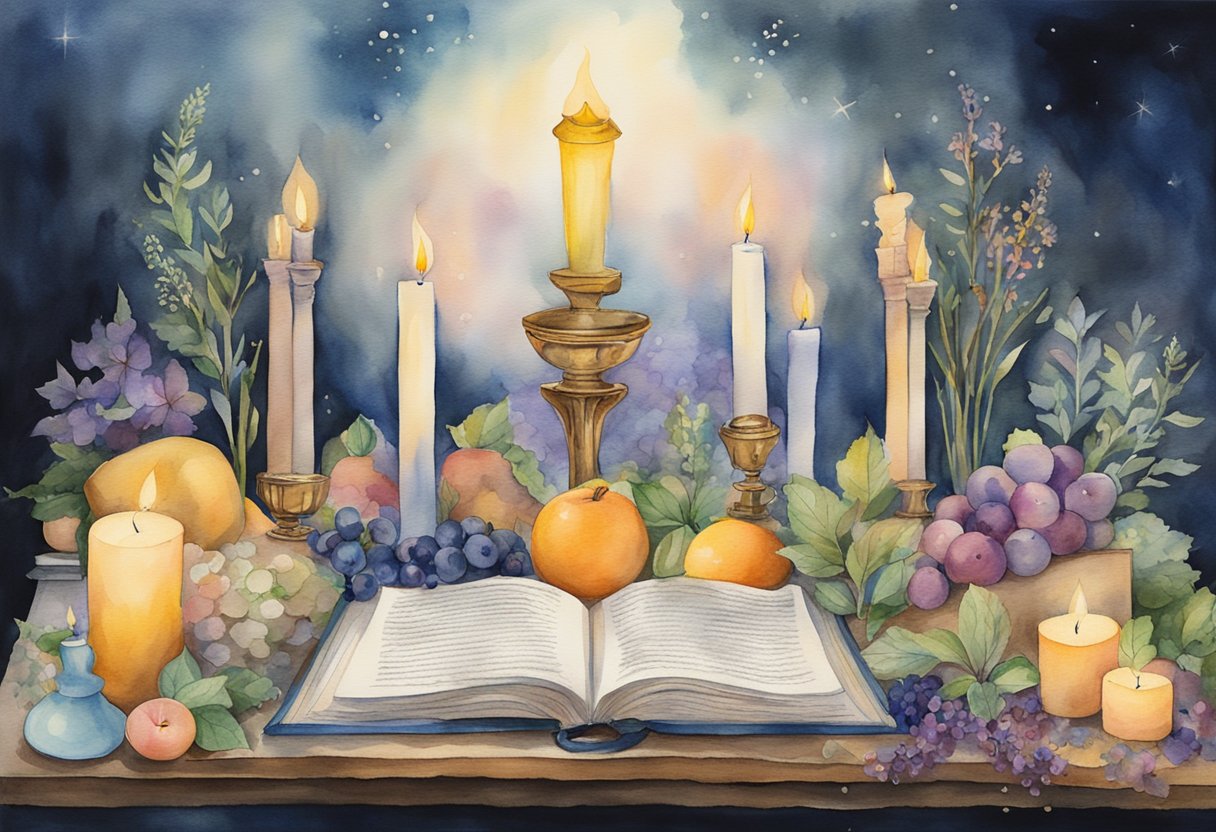
Within the sacred space of their practices, practitioners employ a variety of tools, each symbolizing aspects of the divine or the natural world. The wand, often crafted from wood, serves as a conduit for the witch’s will and intention, directing energy to influence the world around them. A chalice represents the feminine, a vessel holding the waters of life, while the athame, a ceremonial blade, symbolizes the masculine, powerful and assertive. Other instrumental items include candles to illuminate intentions, incense to cleanse and perfume the air, and the pentacle, a star ensconced within a circle, which symbolizes the elements and the interconnectedness of all life. Practitioners often sing, dance, and chant during their rituals to raise energy and manifest their desires.
Celebrating Sabbats and Esbats
Anchored by the Wheel of the Year, Sabbats mark the seasonal festivals that dance to the rhythm of Earth’s journey around the sun. These include four solar festivals—Ostara, Litha, Mabon, and Yule—and four agricultural festivals—Imbolc, Beltane, Lughnasadh, and Samhain. Wiccans also celebrate Esbats, which are rituals aligned with the phases of the moon, often reserved for magic and healing. During these times, a solitary practitioner or a gathering may form a circle as a boundary of sacred space and an altar is set at its center, establishing a focal point for worship. Their heartfelt prayers are intertwined with the Goddess and God, and the high energy of these celebrations can be seen as the dance between light and shadow, death and rebirth, across the Wheel of the Year.
Comparative Analysis
Wicca vs. Paganism
Wicca emerges as a modern pathway to the Divine, crafted from the threads of ancient Witchcraft and presented to the world in the 1950s by Gerald Gardner. This path flourishes under the moonlight, where covens gather, bound by the Threefold Law and an affinity for the Goddess and God. Witches often connote practitioners of this faith, grounded in magic and ritual, and Wicca’s theistic leaning tends towards duotheism—that is, the worship of a Goddess and a God, representative of a greater pantheon or polarity within nature.
| Paganism | Wicca |
|---|---|
| Polythetic umbrella term | A specific tradition |
| Multiple gods or spirits | Typically duotheistic |
| General nature reverence | Strong emphasis on ritual |
| Diverse beliefs and paths | Defined system of magic |
In contrast, Paganism is an umbrella term, broad and wide as the sky, shining down on an array of spiritualities rooted in the reverence of nature. Such a kaleidoscope of beliefs encompasses polytheistic and sometimes monotheistic religions, not exclusive to a single definition. Pagans might dance in many circles, honoring deities who wander a broader pantheon, distinct from the focused reverence in Wiccan practice.
Contrasts with Other Religions
One must tread carefully here, for spirituality is complex. While Christianity, Judaism, and Islam are akin to vast rivers flowing from a singular divine source, Paganism flows like an interconnected delta of spiritual streams, each finding its own way to the sea of divine wisdom. These mainstream monotheistic religions offer structured canons and centralized deity worship, differing from the polytheistic nature of many Pagan religions.
Wicca, on the other hand, could be seen as a single sacred stream within that delta, having its own unique source and course. If one were to compare Wicca with other religious practices, they’d notice a distinct focus on magic and personal experience over scripture, separating it from religions like Christianity. This emphasis on personal connection with the spiritual realm through rituals and the Craft sets Wicca apart, a gem glinting with its own rhythm and practice.
Moreover, it’s crucial to untangle Wicca from misconceptions like associations with Satanism, an entirely different belief system with its own principles, independent from the reverence of the natural world that defines Wicca and broader Pagan paths.
Social Dynamics and Community

Covens and Solitary Practice
In the realm of Wicca, a coven represents a gathering of witches who regularly convene to perform rituals, celebrate Sabbats, and harness their collective energies. Covens typically adhere to a tradition of witchcraft, passing on valued skill sets and wisdom through generations. Each coven may be seen as a close-knit family, with members often bonding over shared spiritual goals and experiences.
Solitary practitioners, on the other hand, embody the free spirit of personal exploration in spirituality. They forge their own path, often embracing a diverse array of tools and rituals to attune with the natural world. While they may sometimes sing and dance under the moonlight alone, these individuals hold the entirety of nature as their sacred space.
Community Events and Networking
The heartbeat of the Pagan community thrives in their gatherings. Festivals and events sprinkle the calendar, offering vibrant venues for both coven members and solitary witches to intertwine. These events serve as fertile grounds for networking, where an exchange of experiences and wisdom can take root and flourish.
Spirituality and tradition dance hand in hand at these community events, often characterized by lively music, workshops, and rituals. They not only foster a sense of connection among like-minded souls but also nourish the skill sets of each participant, enabling them to grow and thrive within their own spiritual path.
Contemporary Challenges and Considerations

Legal Recognition and Rights
The quest for legal recognition unfolds like a ritualistic dance, where practitioners of Wicca and Pagan religions strive for equal footing alongside monotheistic dominions. Witches and pagans often grapple with obtaining the same legal protections afforded to more prominent religions, which includes the right to perform ceremonies in public spaces and the recognition of sabbats and rituals as legitimate religious practices.
- Existing challenges:
- Securing holiday time off for spiritual observances
- Gaining official status for clergy to perform legal rites, such as marriages
Interfaith Relations
Spiritual diplomacy is paramount, as Wiccans and pagans navigate the waters of interfaith relations. They must foster understanding and dissolve misconceptions among monotheistic religions ensconced with their own deep-seated beliefs. It requires building bridges through dialogue, focusing on shared values like the reverence for nature and the sanctity of the spiritual journey.
- Goals for interfacing with other faiths:
- Establish a mutual respect for diverse spiritual paths
- Collaborate on community projects that underscore common ground
Environmental Considerations
Pagans and Wiccans share a profound bond with the Earth, with many traditions emphasizing the sacredness of air, nature, and the fertility of the land as manifestations of various deities. In an epoch where the environment faces unprecedented threats, these groups often take a vocal and active stance on ecological issues, highlighting the spiritual imperative to protect and honor the web of life.
- Key action points:
- Promote sustainability as a core spiritual practice
- Advocate for ecologically responsible policies in the broader community
The realms of legality, intercommunal relationships, and Earth stewardship continue to be theaters of engagement for Wiccans and pagans as they endeavor to manifest their convictions within the framework of contemporary society.

This is so beautifully written. Not only does it encapsulate a vast body of knowledge, the way in which you have expressed that knowledge in your use of the word, is artful. It was a true pleasure to read. Thank you for sharing yourself with such clarity and open expression.