
In the spiritual of Wicca, the Goddess and the God are the warp and weft that create the rich patterns of its beliefs and practices. Rooted in the resurgence of pagan traditions, Wicca emerged in the mid-20th century, intertwining ancient lore with modern sensibilities. The faith beckons its followers to tread a path deeply connected to nature, guided by the divine pair that personify life’s duality and balance. They are the mother and father of all, nurturing and protecting, carrying within them the essence of the earth and the heavens—a celebration of the universe’s eternal dance.
Wiccans embrace a theistic stance that venerates the Goddess and the God, viewing them as dual aspects of a singular divine essence. The Goddess, often depicted as the Triple Goddess – maiden, mother, crone – embodies the moon’s cycles and the earth’s fertility. The God, while sometimes honored in his horned aspect, represents the sun’s life-giving energy and the wild, untamed spirit of the forest. Together, they are revered in an array of celebrations and rituals, each marking the turning of the wheel of the year and the cycles of life, death, and rebirth.
Key Takeaways
- Wicca is a theistic religion worshipping the Goddess and the God, reflecting duality and balance.
- Celebrated through rituals tied to natural cycles, these deities exemplify the interconnectedness of life.
- A personal connection to these divine figures is central to the Wiccan belief system, encouraging harmony with nature.
Origins and Beliefs of Wicca

Historical Roots
Wicca, a religion that emerged in the mid-20th century, is a modern incarnation of ancient, earth-centered beliefs and practices. It pulls from a wellspring of pre-Christian pagan traditions, integrating elements of these older faiths with new ritualistic forms. Gerald Gardner, a pivotal figure in modern Wicca, credited as its foundational father, encountered and absorbed various indigenous religious traditions during his time in Asia. He presented Wicca as a survival of historic European witchcraft, revived in the modern age. Through the works of Doreen Valiente, a high priestess, and Gardner’s publications, Wicca’s presence blossomed. Indeed, figures like anthropologist Margaret Murray influenced its narrative by tracing ritualistic threads back through the fabric of history.
Core Principles and Ethics
Amid the multiplicity of Wiccan paths, a fundamental duotheistic framework prevails, venerating a Goddess and a God. These deities personify a sacred, divine balance reflecting the cycles of nature and life itself. There is an enchanting polyphony in Wiccan belief, for many followers also embrace a polytheistic perspective, honoring a pantheon of lesser deities of the natural world.
Wiccans partake in magic and rituals, reflecting their intimate relationship with nature and the earth. Practices such as crafting a Book of Shadows—a personalized journal of witchcraft, spells, and rituals—are central to the religious life of a practitioner. Embracing the sanctity of divine forces, Wiccan rituals encompass ceremonies during phases of the moon and seasonal equinoxes, times when the veil between worlds is considered thinnest. Covens, or gatherings of Wiccans, often presided over by a priestess or priest, act as communities where these rituals are conducted and wisdom is shared. The Wiccan creed, ‘An it harm none, do as ye will,’ serves as an ethical compass, promoting freedom within the bounds of responsibility to all living things.
Emphasizing moral autonomy and the sanctity of the natural world, Wiccans seek to harmonize their actions with a broader, cosmic dance of energy and spirit.
Understanding the Wiccan Deities

Theological Framework
The foundation of Wicca is deeply rooted in a polytheistic framework, where multiple gods and goddesses are acknowledged and honored. Wiccans recognize a divine spirit as the source of all creation, which manifests in the form of the Goddess and the God, representing the divine feminine and masculine energies respectively. This theology is inclusive, encapsulating a broad pantheon that adopts deities from various cultural backgrounds, thereby enriching the Wiccan practice with a diversity of narratives and symbols.
The Wiccan Goddess
The Goddess is revered in Wicca as a triune deity, known as the Triple Goddess. She channels the Universe’s feminine energies and is venerated in her three aspects: the Maiden, representing youth and new beginnings; the Mother, symbolizing nurture, fertility, and the prime of life; and the Crone, embodying wisdom, repose, and the culmination of the life cycle. The Triple Goddess is often associated with the moon, emphasizing her influence over the natural rhythms and the subconscious.
The Wiccan God
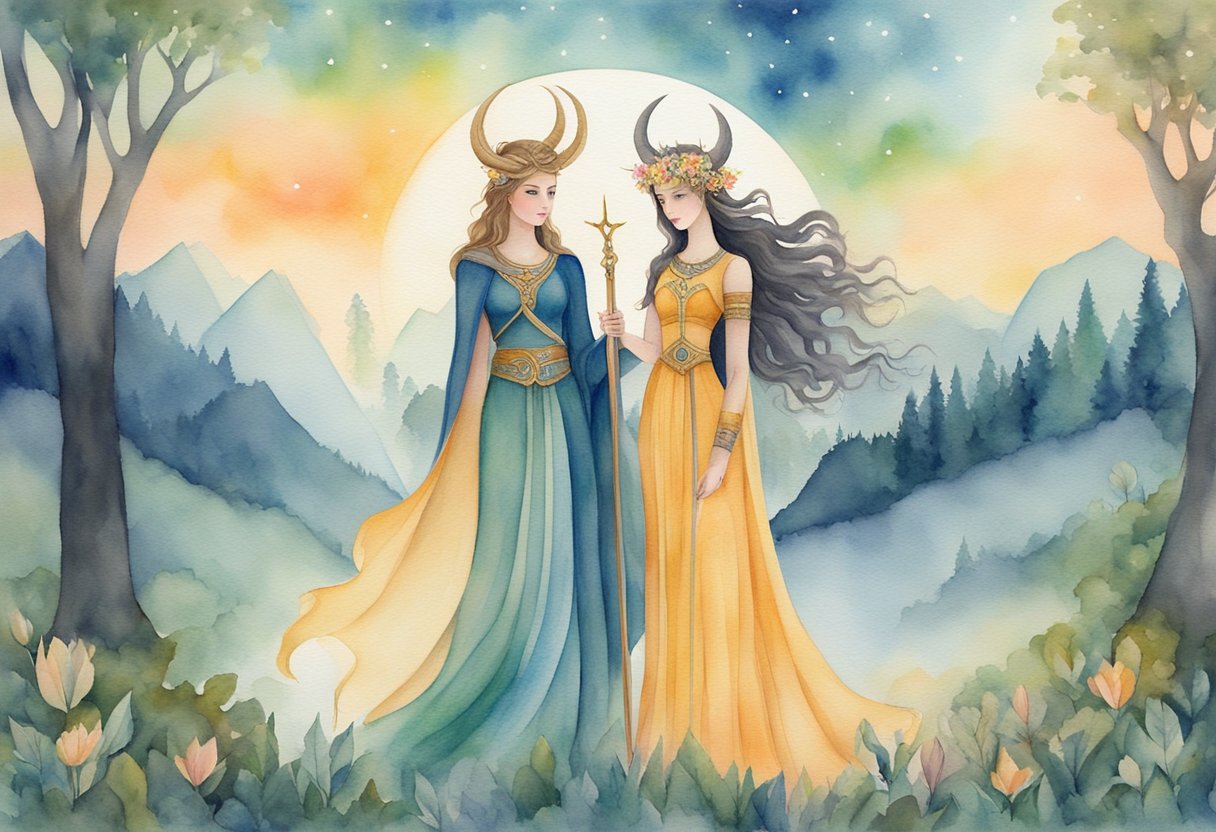
Parallel to the Triple Goddess, the Wiccan God is honored as the Horned God, an archetype of the masculine divine. He embodies the wilderness, animalistic nature, sexuality, and life force. The seasonal cycle of the Horned God’s life—birth, death, and rebirth—mirrors the sun’s journey throughout the year, symbolizing the eternal dance of life and death. He is the consort of the Triple Goddess, together illustrating the wholeness of the Universe and the balance of energies within it.
The Role of Mythology and Symbolism

Mythological Associations
Greek and Roman Influences: The pantheon of Wiccan deities often mirrors aspects of Greek and Roman mythology. For example, the Horned God is reminiscent of Pan from Greek mythology, a deity of the wild, shepherds, and flocks, known for his haunting music. The Roman counterpart, Faunus, also contributes to the concept of the Horned God with his association with forest, plains, and prophecy.
- Celtic Resonance: Celtic mythology bestows rich heritage upon Wiccan beliefs. Cernunnos, the Celtic deity of fertility, life, animals, wealth, and the underworld, manifests in the Wiccan Horned God with his antlers symbolizing the intertwining of the physical and spiritual realms. Herne the Hunter, another figure with antlers from English folklore, brings the protective aspect of the divine masculine into focus.
- Egyptian Insights: Egyptian mythology contributes to Wiccan practices through deities like Isis and Osiris. Isis, aligning with the role of the Wiccan Goddess, symbolizes motherhood, magic, and fertility. Osiris, her consort, reflects the cyclical nature of life and death, akin to the Sun God’s journey through the seasons.
- Norse Contributions: The Norse pantheon, replete with robust symbolism, informs Wiccan mythology as well. The Norse Sun God is seen as the life-giving force, analogous to the Wiccan representation of the male divinity that compliments the Earth Mother, akin to Gaia.
Symbols and Their Meanings
The Triple Goddess: She is most often depicted with three faces or phases—Maiden, Mother, and Crone—to represent the full cycle of female life, aligning with the phases of the moon. These phases signify creation, nurture, and wisdom, respectively.
- The Horned God: He is typically shown with antlers or horns, representing his connection to nature, animals, and the cycles of life. The horns symbolize not only the divine masculine but also potency, protection, and the cyclical nature of regeneration.
Sacred Symbols Table:
| Symbol | Meaning | Related Deity |
|---|---|---|
| Moon | Intuition, the feminine divine, cycle of life | Diana, Artemis |
| Sun | Vitality, the masculine divine, life-giving force | Ra, Norse Sun God |
| Antlers/Horns | Connection to nature, the animal kingdom, regenerative power | Cernunnos, Herne, Pan |
| Triple Spiral | Life cycles, phases of the moon, realms of material existence | Goddess (Maiden, Mother, Crone) |
Through these mythologies and symbols, Wiccans find not only a connection to the divine but also metaphors for understanding the balance and cycles within their own lives and the universe at large.
Celebrations and Rituals

Sabbats and Esbats
Sabbats mark the pivotal points of the Wheel of the Year, encompassing eight major festivals. They reflect the Wiccan dedication to the ebb and flow of nature’s cycles.
- Samhain: A time to honor the ancestors and the thinning veil between worlds.
- Yule: The Winter Solstice celebrates the rebirth of the sun.
- Imbolc: This festival marks the beginning of spring’s return.
- Ostara: The Spring Equinox, a joyous celebration of fertility.
- Beltane: Fires of Beltane ignite the passion of growth.
- Litha: The Summer Solstice basks in the fullness of the sun’s power.
- Lammas: Acknowledgment of the first fruits of harvest.
- Mabon: The Autumn Equinox, a time of balance and thanksgiving.
Esbats are rituals that coincide with the lunar cycle, particularly the full moon, which is seen as a time of heightened energy and power. They gather under the moon’s silvery glow to commune, perform magic, and worship the Goddess in her lunar aspect.
Rites of Passage
Rites of passage in Wicca celebrate the significant turning points in a practitioner’s life journey, often reflecting the natural transitions mirrored in the world.
- Wiccaning: The community welcomes a new child, introducing them to the elements and the divine.
- Initiation: One formally becomes a practitioner of Wicca, sometimes aligning with specific traditions or covens.
- Handfasting: A sacred marriage ceremony, often tying bonds for “a year and a day,” a lifetime, or for all of eternity.
- Parting of the Ways: A respectful acknowledgment of divergence in one’s spiritual path.
Each ritual solemnizes life’s ebb and flow, solidifying the practitioner’s place within the natural order and the broader Wiccan community.
The Magic of the Feminine and Masculine

Balance of Energies
In the cosmos of Wicca, the feminine and masculine energies are seen as complementary forces, akin to the yin and yang of Eastern philosophy. The Goddess, often associated with the moon, embodies the nurturing essence of feminine energy: she is the fertile ground from which life springs and the nurturing force that sustains it. As the waxing and waning moon, she mirrors the cycle of birth, growth, death, and rebirth. The Goddess takes on many forms, from the youthful promise of the Maiden to the wisdom of the Crone, embodying all stages of womanhood.
He, the Horned God, most often represents the masculine energy—vital and potent. As the sun to her moon, the God’s domain is over the wild, unbridled forces of nature and the untamed wilderness. He symbolizes the fecundity of the land and the hunt, culminating in the ultimate sacrifice—the cycle of life feeding upon itself to foster new growth.
Aspects in Wiccan Practice
Wiccans acknowledge the divine couple in their ceremonies and rituals, invoking their energies to maintain equilibrium and to harness the power inherent in their union. A profound reverence for these deities manifests in their rites, where the joining of the Goddess and the God is celebrated, often metaphorically through rituals symbolizing fertility and love. Their dance is one of perfect union and balance, where each force empowers and sustains the other.
This sacred interplay is not merely theoretical. It resonates through Wiccan practice, imbuing magic with the harmonious oscillation of the feminine and masculine. Each spell cast, each ritual performed, seeks to align with this ever-turning wheel, drawing upon the potent energies of creation and destruction, of nurturing and wild abandon—all to achieve a wholeness in both the practitioner’s work and in their spiritual journey.
Ritual Practices and Magic
Casting the Circle
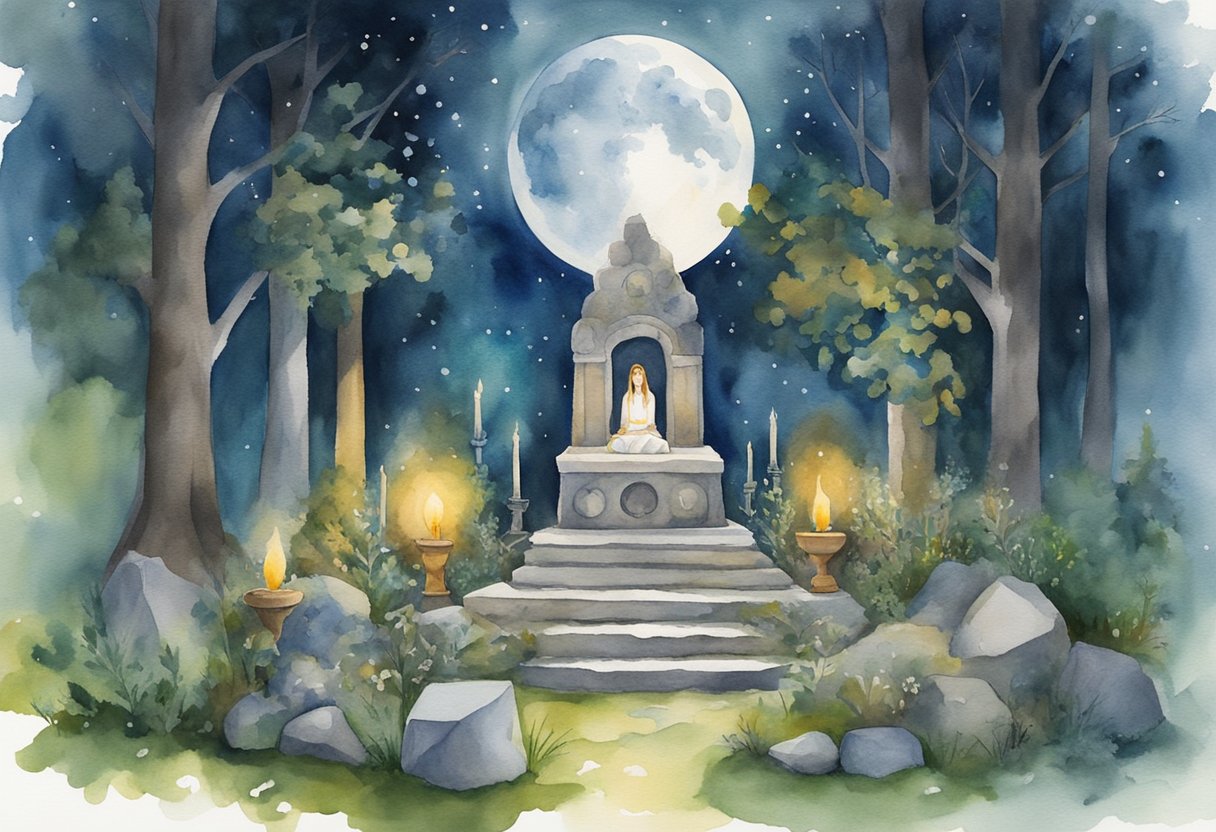
The practitioner initiates their sacred work by Casting the Circle, an act that creates a consecrated space shielding them from external energies. They carefully draw the Circle as a physical and etheric boundary, a symbolic cauldron within which the magic brews. It is here that they merge the seen and unseen, calling upon the energy of the Earth to fertilize their intentions.
Instructions to cast the circle may include:
- Cleansing the space with elements like water or incense.
- Marking the circle’s physical boundaries with stones, crystals, or salt.
- Invoking the cardinal points or “watchtowers” for protection and guidance.
- Ritualistically walking the perimeter—often with a wand or athame—to energetically seal the space.
Invoking the Divine
Within the sacred confines of the Circle, the Wiccan then invokes the Divine, summoning the presence of the Goddess and the God. This act of invocation is not only a request for their attendance but also an opening of oneself to the life force and wisdom they embody. The duality of the divine is honored, as the Goddess brings forth the nurturing power of creation and the God infuses the space with the vital energies of rest and rejuvenation.
The methods of invitation typically involve:
- Chanting or singing to resonate with the divine frequencies.
- Using statues or symbols to represent the deities’ physical forms.
- Offering libations or sacrifices as tokens of respect and gratitude.
- Engaging in dance or movement to embody the divine energy within the ritual space.
The energies of the Goddess and God are entwined in the Wiccans’ work, their essence vital for the transformative power of magic to align with the pulse of the universe, guiding practitioners in their spiritual journey.
The Wicca Connection with Nature
Seasonal Observances and the Earth’s Cycles
Wiccans attune themselves to the Mother Earth’s heartbeat through the Wheel of the Year, marking the changing seasons with eight sabbats. These sabbats include the solstices—heralds of the sun’s glory at its peak and its slumber in the depths of winter—and the equinoxes, moments of equilibrium when day and night embrace as equals. The sabbats of Samhain (autumn’s final whisper), Imbolc (winter’s soft farewell), Beltane (spring’s vibrant kiss), and Lughnasadh (summer’s bountiful embrace) honor the Earth’s continuous cycle of death and rebirth, fostering a deep connection with the transformative process of change and growth.
- Samhain: Celebrating the end of the harvest and the start of the darker half of the year.
- Imbolc: Acknowledging the first stirrings of spring and the rekindling of light.
- Beltane: Reveling in the fertility and lushness of life at spring’s peak.
- Lughnasadh: Giving thanks to the early harvest and the warm spirit of summer.
As the moon’s phases cast the night in silver, so too do Wiccans find in the lunar cycle a reflection of life’s ever-spinning wheel—each phase a different facet of the divine.
Animals and the Natural World
Creatures both great and small are revered, their spirits intertwined with the sacred tapestry of the wild. The stag, a symbol of the Horned God, stands as a majestic testament to the power and virility of the forest. Within Wiccan beliefs, this deity is not merely a hunter but a guardian of the animals and the cycles of life, embodying the instinctual drive to survive and the tender care needed to sustain the flock.
The Green Man, with his foliage-adorned visage, breathes the soul of the forest through the whispering leaves, reminding all that life persists in the most resilient of forms. He is a manifestation of nature’s indomitable will, changing with the seasons yet ever rooted in the earth.
Wiccans also hold the sea in great reverence, acknowledging its unfathomable depths and teeming life. They see the ever-shifting tides as a mirror to nature’s flux, its ebbs and flows a hymn to the inexorable passage of time and the mysteries that night enfolds.
Wicca’s connection with nature is a spiritual tapestry, interwoven with threads of reverence for the earth, adoration for its cycles, and a profound bond with the denizens of the natural world.
Understanding the Controversies
Misconceptions and Misunderstandings
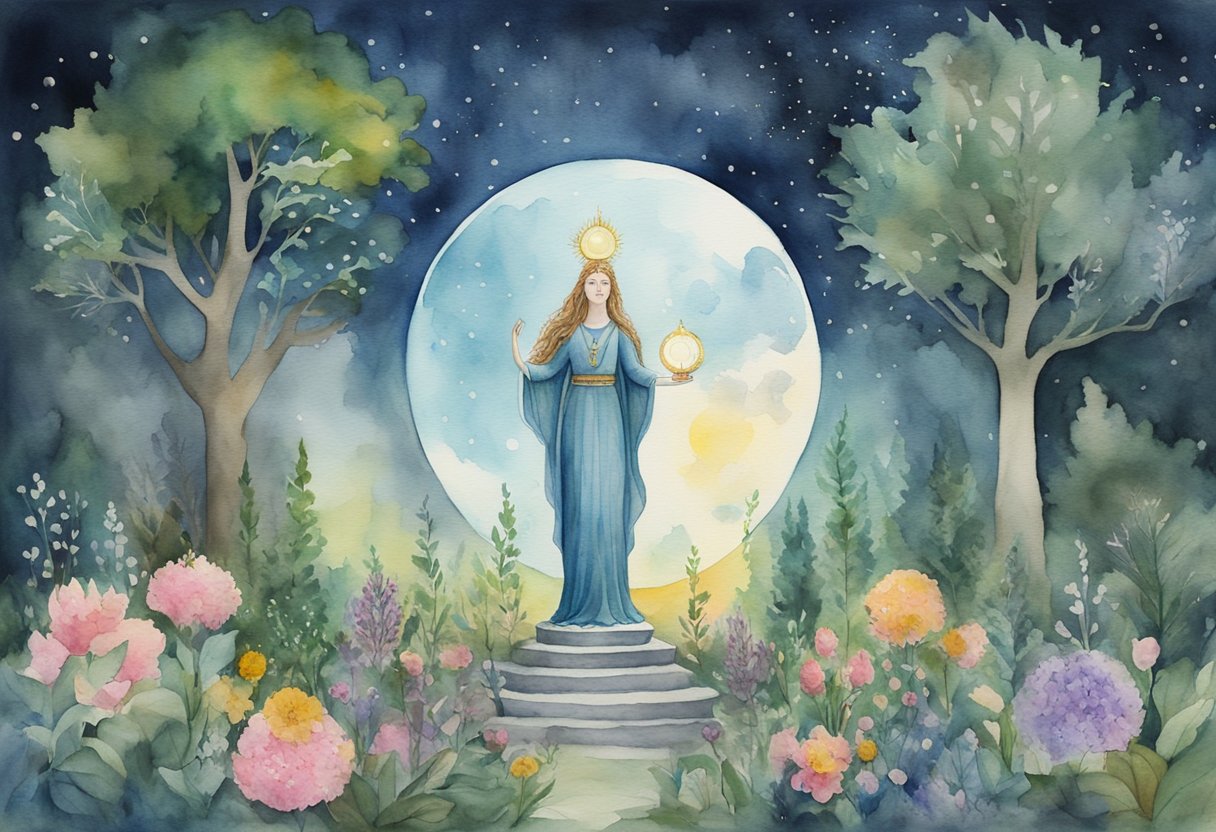
Misconceptions about Wicca run rampant. At their core, the Goddess and God represent a duality in nature, but they are mistakenly equated with evil or the devil by those who may only see Wicca through the lens of their own Christian beliefs. Such comparisons are like mistaking the gentle glow of the moon for the harsh glare of the sun. The Wiccan deities are not polar opposites of Christianity’s entities; rather, they are distinct in their own right, embodying balance and encompassing both light and shadow, which is often misunderstood.
- Evil: Contrary to popular belief, Wiccan deities are not associated with evil or satanic practices.
- Stereotypes: The horned image of the God is frequently misconstrued, linking him incorrectly with demonic figures due to historical Christian iconography.
Wiccans face a challenge as they must dispel stereotypes that position their deities as malevolent when, in truth, they symbolize natural cycles and the human connection to the earth.
Wicca in the Modern World
The portrayal of Wicca in pop culture often obscures the true essence of its deities. Television and film abound with depictions of witches and warlocks that stray far from the spiritual path of Wicca, projecting them instead as purveyors of dark arts. These portrayals in mainstream media have heavily influenced modern perceptions, creating a chasm between reality and fiction. As a spiritual path, Wicca embraces nature and the divine in a way that is often overshadowed by these dramatic misrepresentations.
- Pop Culture: Series and movies have shaped an image of Wicca that is more fictional than factual.
- Modern Perceptions: Nuanced understandings of the Wiccan deities are often omitted in favor of sensationalized oversimplifications.
It is vital to understand that Wicca is not about wielding supernatural power over others, but rather it’s an intricate dance with the natural world, celebrating life’s rhythms and mysteries.
Building a Personal Connection
Finding Your Path
For seekers, the journey to divine connection is a solitary hike through a wooded glen, their footsteps guided by the whispers of intuition. Personal practice becomes a sacred map, with rituals and meditations serving as waypoints to personal growth. They may uncover potent symbols that resonate with their soul or encounter deities that mirror their innermost workings.
- Rituals: Moon phases, Sabbats, Esbats
- Meditation: Daily practice, Mindfulness, Visualization
- Symbols: Pentagram, Triple Moon, Ankh
The Role of the Community
On this voyage, community acts as both anchor and compass. Covens and solitary practitioners alike find strength in the shared chorus of chanting and celebration. Within the caring embrace of a coven, mentorship blossoms, offering fledgling witches a nurturing ground to root their burgeoning powers.
- Covens: Collective worship, Shared rituals
- Community: Festivals, Workshops, Public rituals
- Mentorship: Guidance from experienced practitioners, Learning through tradition
Fellowship is more than mere congregation; it’s the soul’s reflection in the mirror of the collective spirit. The Wiccan community, diverse as the stars in the firmament, supports each individual’s spiritual path while creating a quilt of interconnected wisdom.
